Author: Eric Magers

  • AP Calculus AB: Implicit Differentiation

    AP Calculus AB: Implicit Differentiation

    As the Advanced Placement (AP) testing season nears this spring, it is important to familiarize ourselves with the content matter. According to College Board, differentiation: implicit, composite, and inverse functions will be 9-13% of the test score in 2022.

    To develop a better understanding of implicit differentiation, we need a brief semantic breakdown of the two types of functions: implicit and explicit. We must recognize that “implicit” and “explicit” are antonyms, while “explicit” means “clearly defined or expressed,” “implicit” means the latter. In the following sections, we will touch upon concepts like functions, derivatives, and the chain rule, all of which are pertinent to the AP Calculus AB Exam.

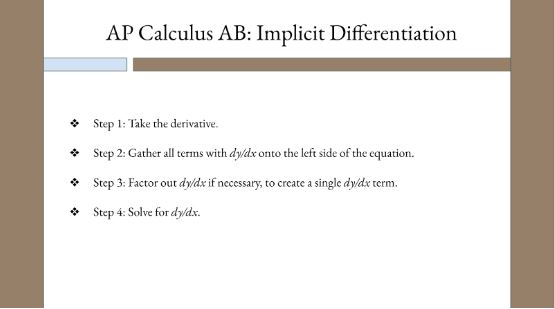
    What do we do when y isn’t clearly expressed as a function of x, or vice versa, much like in implicit functions? Well, there are three main steps to successfully differentiate an equation implicitly. Firstly, we take the derivative. Secondly, we gather all terms with dy/dx onto the left side of the equation. Thirdly, we factor out dy/dx if necessary, to create a single dy/dx term. Fourthly, we solve for dy/dx.

    Let’s have a look at a sample problem: “find dy/dx for y² – 5x³ = 3x.

    In step 1, we take the derivative.

    2y dy/dx – 15x² = 3 dy/dx


    In step 2, we gather all terms with dy/dx onto the left side of the equation.

    2y dy/dx – 3 dy/dx = 15x²


    In step 3, we factor out dy/dx if necessary, to create a single dy/dx term. 

    dy/dx (2y – 3) = 15x²


    In step 4, we solve for dy/dx.

    dy/dx = 15x²/2y – 3


    Hopefully, this has facilitated your use of implicit differentiation as a method to differentiate implicitly defined functions, and you are now able to complete your exam with a firm resolve.


    By: Estefania Olaiz

    March 20, 2022

    Sources:

    1. https://www.cliffsnotes.com/study-guides/calculus/calculus/the-derivative/implicit-differentiation 
    2. https://tutorial.math.lamar.edu/classes/calci/implicitdiff.aspx
    3. https://www.mathsisfun.com/calculus/implicit-differentiation.html
    4. https://www.mathsisfun.com/calculus/implicit-differentiation.html
    5. https://library.fiveable.me/ap-calc/unit-3/implicit-differentiation/study-guide/k43S7kJDyGg9NFUm78Uw 
    6. https://ivytutorsnetwork.com/blog/how-to-study-for-the-ap-calculus-ab-exam


  • Inspiring Students to Think like Scientists

    Inspiring Students to Think like Scientists

    Image source

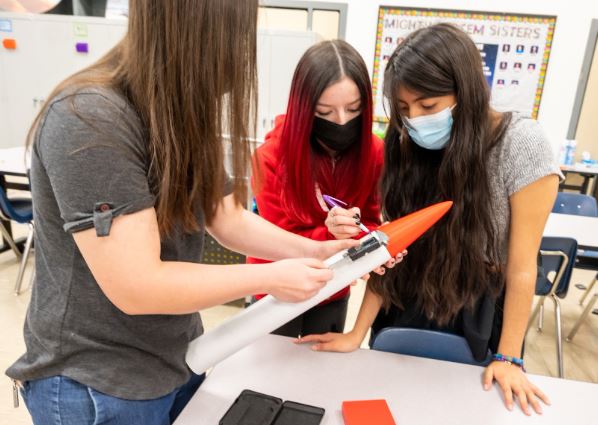
    Inspiring students to think like scientists teaches them how to be capable and independent learners. It also allows them to understand the material more thoroughly, and prepares them for the future. Here’s how you can inspire children to think and act like scientists!

    1. Encourage curiosity of nature and science

    Passion and interest are the most important parts of being a scientist. Students should be motivated to learn and work hard. Here’s how you can appeal to their curiosity when teaching:

    • Guide them to ask essential questions and draw their own conclusions
    • Make learning fun: have hands-on activities, engaging videos, and content that will pique their interest
    • Give them opportunities to share their learning with the class and encourage them to share it with their family at home as well
    • Show them how science connects to their everyday lives to encourage their interest and awareness of science. For example, let them think about how laws of physics apply to roller coasters. 
    • Similar to the above, show them how science is a part of major real world issues such as global warming
    1. Provide them with opportunities to work with others

    Collaboration and working with others are key parts to being a scientist. Many important scientific discoveries were not done alone but as a group. Teach students how to learn from and help others. Teamwork makes the dream work! You can do this by:

    • Having class discussions or opportunities where students share their ideas
    • Having group projects or have students work together in table groups
    • Having labs and other hands-on activities that are partner or group activities
    1. Let them discover their own conclusions

    Many textbooks tell students concepts and explain why they work, but scientists in the real world do not have textbooks telling them the answers. Often, activities where students can find things out for themselves are much more effective than reading a textbook or listening to a lecture, because the student will absorb the information and remember it much better.

    • Provide opportunities like experiments and labs that are engaging and let students discover scientific concepts themselves. For example, for gas laws, have a lab where students have to do different experiments with balloons so that they can observe and learn about the relationships between pressure, temperature, and volume. 
    • Other than hands-on activities, you can also let them create graphs to understand relationships better, or have them identify patterns in a series of data.

    Image source

    1. Help them connect their learning across various subjects

    The understanding of how science connects to other disciplines is fundamental and extremely useful for scientists. 

    • Math: calculations in science can often seem daunting to students. Help them understand the concept behind it and then show how that translates into an equation. Understanding how the equation works makes it much easier to remember and use. Graphs are also a powerful tool in science that students should know how to read and make. They can illustrate patterns and the relationships between two variables. 
    • Reading: reading comprehension skills are very important because scientists do tons of research on the topics they are studying to learn more and understand their topic the best they can. Have students take notes on articles or textbook chapters or have a research project so that they can learn how to connect their learning across a variety of sources, pick out and absorb important information, and make sure the sources they use are trustworthy.

    By Vivien Chen

    Date: April 12, 2022

    Sources

  • Record High Temperatures in Antarctica

    Record High Temperatures in Antarctica

    Image Credit

    On March 18, 2022, the Concordia research base at Dome C of Antarctica, one of the coldest places in the world, reported that temperatures had reached a shocking 11.3 degrees Fahrenheit, or -11.5 degrees Celsius. The research station is 9,800 feet above sea level, operated by French and Italian researchers. 

    March marks the end of summer in Antarctica. Normally, at this time of year, inland temperatures fall to an average of -56 degrees Fahrenheit (-49 degrees Celsius), making the temperature recorded on March 18 almost 70 degrees higher than usual. Scientists believe it has set a world record for the highest temperature above normal in any continent. 

    Researchers are scrambling to make sense of the occasion. Such an extreme meteorological event has never been observed in Dome C. It currently can’t be proven that climate change contributed to the drastic temperature change, but scientists have said that human-caused climate change almost definitely played a part, according to The Washington Post

    Other scientists are analyzing recent meteorological events for an explanation. An atmospheric river, a narrow passage in the atmosphere that transfers water vapor, had recently passed by and brought large amounts of ocean moisture onto the land. Just the day before on March 17, the ice sheet was almost the wettest it had been since 1980. There was also an arrival of hot air, which is very rare in the Antarctic at this time of year. The moisture from the atmospheric river could’ve trapped the hot air on the land and caused the heat wave. 

    This isn’t the only strange event that has happened in Antarctica in recent months. In late February, Antarctica’s sea ice level fell below 2 million square kilometers for the first time since 1979. On March 15, an ice shelf nearly the size of New York City completely collapsed, becoming the first Antarctic ice shelf in human history to collapse. This was most likely due to the incoming heat wave, as temperatures had already begun to reach record high levels at the time. 

    This event, while extreme, won’t have a very significant impact on Antarctica nor the rest of the world. However, it is important to keep an eye out for similar occurrences and what this could mean for the future.

    Image Credit

    Sources:

    www.cbsnews.com/news/antarctica-record-shattering-warmth-historic-event/ 

    www.cnn.com/2022/03/28/weather/antarctica-world-record-high-temperature-anomaly-climate/index.html 

    www.nbcnews.com/science/science-news/heat-wave-snowfall-researchers-are-puzzled-antarcticas-recent-weather-rcna21120 

    www.noaa.gov/stories/what-are-atmospheric-rivers 

    www.washingtonpost.com/weather/2022/03/18/antarctica-heat-wave-climate-change/ 

    earth.org/east-antarctica-ice-shelf-collapses-for-the-first-time-in-human-history/#:~:text=Following%20an%20unprecedented%20heat%20wave,human%20history%20in%20the%20region.


    Written By: Vivien Chen

    Date: March 31, 2022

  • 6 Influential Women in Chemistry

    6 Influential Women in Chemistry

    Over the course of history, many women have made meaningful and inspiring contributions to the field of science. Here are 6 women throughout history who made significant contributions to chemistry. 

    1. Rachel Holloway Lloyd

    Born in 1839, Rachel Holloway Lloyd grew up in a time where female scientists were rare. She was the first American woman to earn a Ph.D. in chemistry and the second woman to join the American Chemical Society. Three of her papers were published in the American Chemical Journal, making her the first woman to publish a paper in that journal. 

    Lloyd is most known for her research on beets. She analyzed the chemistry of sugar beets and how they reacted with Nebraskan soil to see if they could grow in northern climates. Through her research, the beet industry in Nebraska became very successful and still is to this day. Lloyd also taught chemistry at the University of Nebraska until she retired in 1894. She was a great role model for future women in chemistry.

    1. Mildred Cohn

    Mildred Cohn was an intelligent biophysicist and chemist who studied chemistry and its connection to life sciences. She started college at the age of 15 and graduated 3 years later. She also received her master’s degree and Ph.D. at Columbia University.

    As a Jewish woman, Cohn fought against gender and religious discrimination. After graduating, many jobs she applied for did not even offer her an interview. She first got a job at George Washington University to research how chemical reactions occur in animals. In 1946, she joined a biochemistry laboratory in Washington University, Missouri, where she studied enzymes. 

    In 1948, she joined the University of Pennsylvania’s biophysics department. She researched adenosine triphosphate, commonly abbreviated as ATP, a chemical compound that transports energy in our cells. Her methods of studying enzymes and other molecules became adopted by many other scientists to study metabolic processes. 

    Cohn was the first woman to join the board of the Journal of Biological Chemistry, where she was an editor for 10 years. She was also the first woman president of the American Society for Biochemistry and Molecular Biology. She retired in 1982, the same year she received the National Medal of Science, an honor bestowed from the president for people who make great contributions to science and technology. 

    1. Stephanie Kwolek

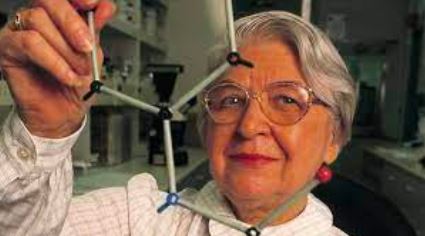
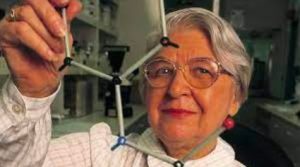
    Stephanie Kwolek is most known for her discovery of Kevlar, an extraordinarily strong and light material. She worked as a chemist in a company called DuPont. Tasked by DuPont, she started searching for a synthetic material that could withstand extreme conditions. In 1965 she discovered that with certain conditions, a large number of molecules could form fibers with very high strength and stiffness, five times stronger than steel. Kwolek patented the material in 1966 and DuPont named it Kevlar.

    The discovery of Kevlar opened many possibilities. It can be used as lightweight body armor and has saved the lives of many policemen and soldiers. It can also be used to suspend bridges, make protective clothing for athletes, and much more.
    1. Mary Lowe Good

    Mary Lowe Good was planning to become an economics teacher, but one fateful day, she learned about Marie Curie in her required chemistry class. Captivated and inspired, she switched her major to chemistry. She went on to contribute greatly to the field. 

    In 1967, Good pioneered an experimental technique called Mössbauer spectroscopy, which uses gamma rays to figure out the molecular structure of complicated compounds containing metal ions. 

    Good is best known for her public service. She was the president of the American Chemical Society. In 1991, President George H. W. Bush appointed her to the President’s Council of Advisors on Science and Technology. In 1993 she became the undersecretary for technology in the U.S. Department of Commerce under President Bill Clinton, and she advised many other presidents on science as well. She was also elected president of the American Association for the Advancement of Science in 2001. She received many awards for her contributions and outstanding service to the nation. 

    1. Tu Youyou

    Tu Youyou is a Chinese chemist who was born and raised in Ningbo, China. After contracting tuberculosis at 16, she decided she was going to study medicine. In 1969, she was appointed the head of a Chinese project to find a cure for malaria. She traveled to areas in southern China where she saw just how devastating the disease was. 

    Youyou used past Chinese medical texts from the Zhou, Qing, and Han Dynasties to search for a cure. In 1971, she and her team discovered a compound called artemisinin, and when they tested it on themselves and test patients, all of them recovered! They had found the cure, saving the lives of millions of people who were dying from the disease. 

    Youyou received the Nobel Prize in Physiology and Medicine in 2015, becoming the first mainland Chinese scientist to have received a Nobel Prize in a scientific category.

    1. Jennifer Doudna

    Jennifer Doudna is an American biochemist at the University of California, Berkeley. With her partner Emmanuelle Charpentier, she discovered the revolutionary tool CRISPR. CRISPR has the ability to edit genes by finding DNA inside a cell and altering the DNA sequence. It is a groundbreaking discovery that allows for a simple and cheap way to edit genes and unlocks many possibilities. 

    CRISPR has been used for scientific research and altering the genes of plants and animals for food. It also has the potential to be used in medicine, allowing us to prevent and treat previously incurable diseases. But there is also controversy surrounding this powerful tool. Is it ethical to use CRISPR on human genes, possibly causing mutations and harm for future generations? 

    Nonetheless, the creation of CRISPR was a huge scientific breakthrough, and Doudna and Charpentier received the 2020 Nobel Prize, becoming the first all-female team to win the Nobel Prize in Chemistry.

    By Vivien Chen

    Sources
  • Future of Computing

    Future of Computing

    Computers have made it a long way since the invention of Colossus, which was the computer built by British scientists to crack the Enigma code. Back then, computers would fill entire rooms and require a team of engineers to run. Now, less than a century later, they’re compact enough to fit inside of a pocket. But let’s look at what the future may have in store for computing (ScienceNews).

    Image credit

    Artificial intelligence is a phrase that gets thrown around a lot in science fiction movies, but what does it actually mean? Technically, artificial intelligence is already here. It’s what filters search results to our liking and recommends videos, songs, and TV shows to us in streaming services; done via a process of analyzing statistics and creating algorithms automatically known as “machine learning.” We even have artificially intelligent cars that can drive us to our destinations. But these forms of artificial intelligence are made to fulfill specific purposes. What about AI that can think like a human? This is a concept known as artificial general intelligence, or AGI. Alan Turing famously devised a test to determine whether a computer could be considered thinking. If a human could have two conversations, one with a computer and the other with a human, and not be able to guess which was the human or the computer, then the computer passed the Turing test. Until we can achieve that, AI will largely rely on machine learning to stay as advanced as it is (TowardsDataScience).

    One of the main building blocks of computers, as well as other electronic devices, are transistors. Transistors serve two basic functions. The first is amplifying currents. One end of a transistor may take in a smaller electric current while the other end outputs a much larger current. The other function of a transistor is acting as a sort of switch. One small current may determine the output of larger currents, much like the valve on a faucet (PhysLink). Transistors have become smaller and smaller over time, and now a single computer chip can hold hundreds of millions or even billions of transistors. But as transistors continue to get smaller, it is expected that we may hit a limit of how small they can physically get, meaning that improvements will have to be found elsewhere. The current design for transistors, known as “FinFET,” will likely be replaced in favor of a new design called the “gate-all-around” design. This new design is expected to use less energy, take up even less space, and work faster than current transistors (ScienceNews).

    Image credit

    Another major development we may see in the coming years is the use of quantum computing. Quantum computers are built upon the science of the supersmall, and in the future, could completely transcend the capabilities of current computers. For now, though, quantum computers are impractical. An IBM quantum computer in New York is currently capable of simple calculations. What separates quantum computers from current computers is the use of “qubits.” Whereas a normal computer will store information in terms of bits (ones and zeroes), a quantum computer can use qubits, which can represent the values of one, zero, or both at the same time, something known as a quantum superposition. This allows for parallel computations that will speed up the process of working out solutions. Once quantum computers become more powerful, they will revolutionize the way computing is done (ScienceNews, the last source listed, the article about quantum computers).

    With the rapid speed that computers have been developing over recent years, what was once thought to be science fiction is now a reality, and further development of computers will only exceed our current understanding of technology and the capabilities of computing. So be on the lookout for the amazing changes that may happen in the future!.


    Written by: Matthew Jenkins

    Date: March 14, 2022


    Source:

    https://www.sciencenews.org/century/computer-ai-algorithm-moore-law-ethics#chasing-intelligence

    https://www.physlink.com/education/askexperts/ae430.cfm

    https://towardsdatascience.com/what-is-artificial-general-intelligence-4b2a4ab31180

    https://www.sciencenews.org/article/quantum-computers-are-about-get-real

  • Brain Awareness Week

    Brain Awareness Week

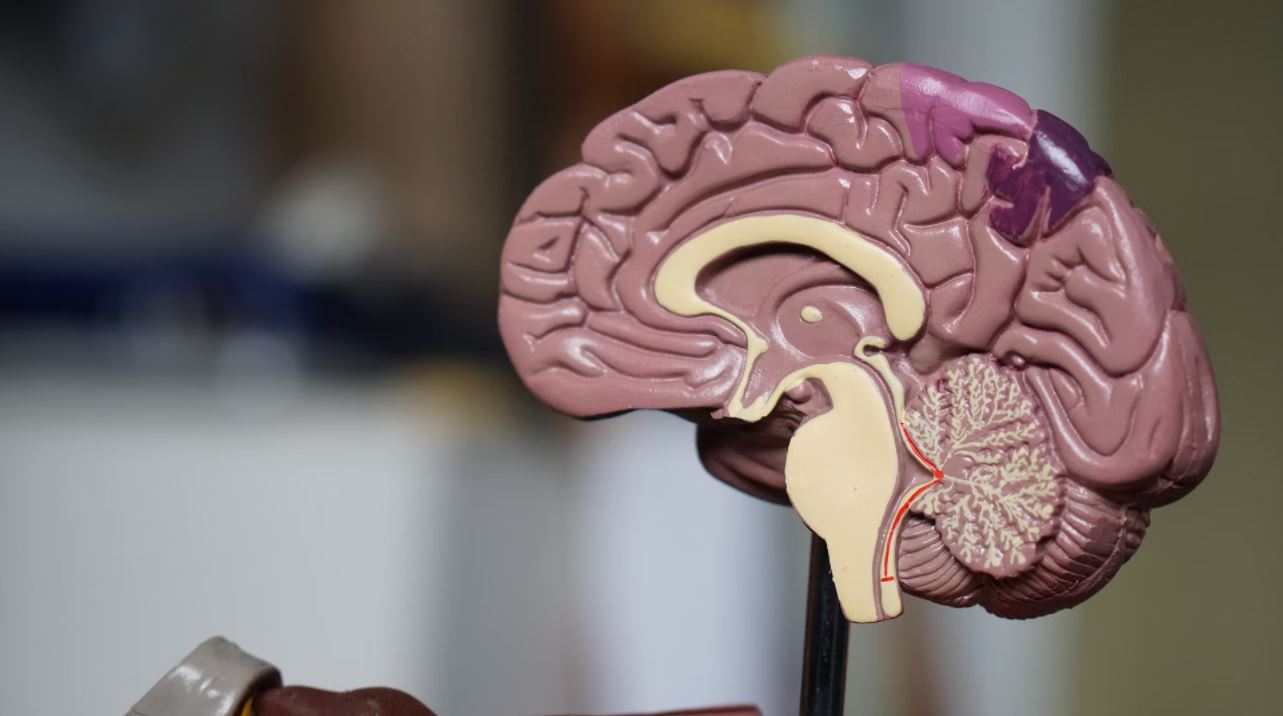
    The human brain – it’s the only organ that named itself! It’s what makes each of us who we are, and the machine that helps us make sense of the world. It goes without saying that humans should always be taking care of their brains, and that’s why people all around the world take one week each year to celebrate brain awareness.

    Image credit

    Brain Awareness Week is a worldwide awareness campaign to get the public interested in the science of what is arguably the most important organ in the human body. It was started by the Dana Foundation in 1996 and has continued annually since then. It now has more than 7,300 participating partners including K-12 schools, colleges, advocacy groups, etc. in 120 countries. Brain Awareness Week events range anywhere from lectures to museum exhibitions, and they all seek to increase education and awareness about the brain and brain health.

    So in recognition of Brain Awareness Week, let’s take a closer look at how we can better take care of our brains. Here are some tips for improving brain health:

    1. Exercise is one of the best ways to take care of your brain. Studies show that people who exercise regularly have a lower chance of developing diseases like Alzheimer’s and dementia. This is possibly due to the fact that exercise increases blood flow to the brain (Alzheimers.org).
    2. Social interaction is another important factor in brain health. The more we interact with friends and loved ones, the more our brains are stimulated. More brain stimulation lowers our chances of stress and depression, which take a huge toll on mental health (Physiology).
    3. Getting good sleep isn’t just important for your energy levels during the day. It also serves an important function in removing toxins from your brain which build up while you are awake (NINDS).
    4. Protect your head and avoid injuries! When you ride a bike or play a rough sport like football or hockey, make sure to wear a helmet. Protecting your head with a helmet can prevent your risk of getting a concussion or another head injury that can negatively affect the brain. Especially for young athletes, a concussion can negatively affect mental processes, which can mean a drastic reduction in academic performance.

    Image credit

    And now that you know how to keep your brain healthy, here are some more facts about the brain that will hopefully make you more excited about Brain Awareness Week:

    1. Scientists have discovered that there is a link between a change in brain size and the amount of sleep a person gets. Generally, as someone loses the ability to fall asleep quickly, the size of the brain decreases. However, scientists still do not know whether it is the lack of sleep that causes a decrease in the size of the brain, or if the decrease in brain size causes a lack of sleep (AAN).
    2. The ancient Egyptians did not view the brain as an important organ. Or at least, not as important as other organs such as the heart. As such, they did not believe it would be required in the afterlife and removed it piece by piece through a person’s nose in the mummification process (UCL). The importance of the brain as the center of thought was first theorized by a Roman physician named Galen around 170 BC (University of Queensland).
    3. New parts of the brain are still being discovered by scientists. As recent as 2021, scientists discovered a new part of the brain that helps with the process of recognizing faces (Open Access Government)!


    The brain is a fascinating thing, so this Brain Awareness Week, take a few moments to appreciate and learn more about the organ that makes you who you are!


    Written by: Matthew Jenkins

    Date: March 20, 2022


    Sources:

    https://brainawareness.org/about/

    https://www.alzheimers.org.uk/about-dementia/risk-factors-and-prevention/physical-exercise

    https://journals.physiology.org/doi/full/10.1152/physrev.00041.2007

    https://www.ninds.nih.gov/Disorders/Patient-Caregiver-Education/Understanding-Sleep

    https://www.aan.com/pressroom/home/pressrelease/1305

    https://blogs.ucl.ac.uk/researchers-in-museums/2018/02/21/neuroscience-in-ancient-egypt/

    https://qbi.uq.edu.au/brain/intelligent-machines/understanding-brain-brief-history

    https://www.openaccessgovernment.org/brain-remembers-faces/114611/