Author: Eric Magers

  • Facts About Bone Health

    Facts About Bone Health

    Osteoporosis is a condition that relates to bone density and affects an estimated 10 million adults over the age of 50 in the United States. The condition causes bones to become brittle over time as they become less and less dense, making them more likely to fracture or deteriorate (health.gov). Bone health is a complex topic for scientists because a large number of factors are responsible for the growth and deterioration of bone, including gut health and kidney health. Scientists are constantly uncovering new information about how bones stay healthy and how to prevent the onset of conditions, such as osteoporosis, which threatens bone health.
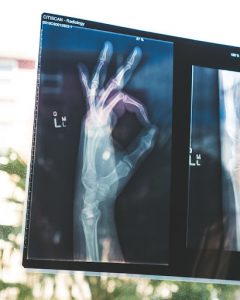
    Image Credit

    Research in recent years suggests that gut health is strongly linked to bone health. The vast assortment of microorganisms located within the gut is known primarily for its role in digesting food, but it also affects how bones develop over time. A 2012 study using mice discovered that a lack of microorganisms contained within the stomach led to an increase in bone mass. Furthermore, by reintroducing microbes into the gut, scientists were able to get bone density back to normal (asbmr.olinelibrary.wiley).

    During the experiment, when the mice had no microbes in their guts, scientists observed that their bodies produced fewer osteoclasts (asbmr.onlinelibrary.wiley), which are cells that degrade bone in order for the natural remodeling of bones to occur (NIH). These findings are exciting to scientists who never before predicted that these two parts of the body were so closely linked.

    Osteoclasts work hand in hand with other cells called osteoblasts that act as the building blocks for bone growth. The cooperation of these cells is what allows the bone structure of children to reform into an adult bone structure later in life. There is also a third group of cells which affects bone development: osteocytes. For many years, very little was known about the purpose of osteocytes. However, in 2006, a scientist named Lynda Bonewald discovered that osteocytes may be more important than scientists realized at the time (knowablemagazine).
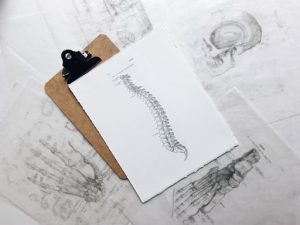
    Image Credit

    Bonewald found that osteocytes produce a growth factor called FGF23. FGF23 travels to the kidneys through the bloodstream, and when too much FGF23 is present, it causes the kidneys to release too much phosphorus from the body in urine. If too much phosphorus is released, the body may experience softened bones as well as other harsh symptoms (knowablemagazine).

    Bones are more complex than most people realize, not just in the way they maintain their structure, but in the way they are directly linked with other parts of the body. Scientists have only just scratched the surface of how bone cells interact with other organs.

    Written by: Matthew Jenkins

    Date: May 2, 2022

    Sources:

    https://health.gov/healthypeople/about/workgroups/osteoporosis-workgroup

    https://asbmr.onlinelibrary.wiley.com/doi/full/10.1002/jbmr.1588

    https://pubmed.ncbi.nlm.nih.gov/19883363/

    https://knowablemagazine.org/article/health-disease/2022/fun-facts-about-bones-more-just-scaffolding

  • STEM books for grades 3 to 6th

    STEM books for grades 3 to 6th

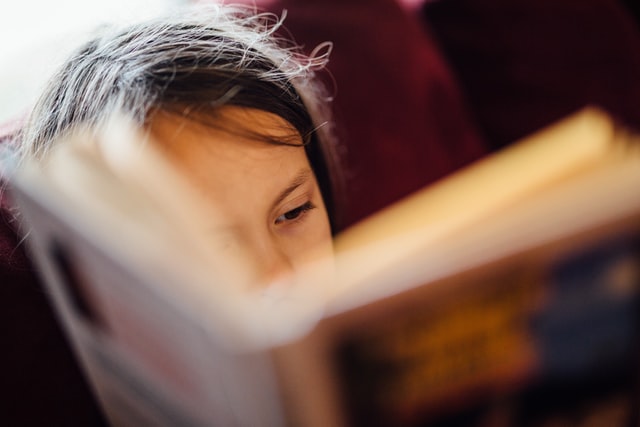
    Having trouble getting your children interested in STEM subjects? Reading is one of the best ways to get young children to learn and incorporating STEM into their reading can help get them excited about STEM subjects. Luckily, there are so many books available that can help teach them about STEM subjects in a fun and engaging way. Some publishers even make it easy to find STEM-related books by having an entire categorization for their STEM-related books, fictional and nonfictional alike.

    Image Credit

    Here are some STEM-related books for students in grades three through six to help get children started on their STEM journeys.

    1. Tiny Stitches: The Life of Medical Pioneer Vivien Thomas by Gwendolyn Hudson Hooks

    This nonfiction book, geared toward a 4th-grade reading level, deals with the science of surgical procedures and details the creation of the “Blalock-Taussig shunt,” a surgical technique developed in the 1940’s which increases blood flow to the lungs in certain cases. The procedure was developed by a surgeon named Vivien Thomas, who went uncredited for the procedure. Thomas had to fight discrimination and resistance from his colleagues for the recognition he deserved as a pioneer in medicine. If your child is interested in history, this book may be perfect for exposing them to the wonders of medical science!

    Link: https://www.leeandlow.com/books/tiny-stitches

    2. Prairie Dog Song by Susan L. Roth & Cindy Trumbore

    Does your kid love animals? This book is a great way to introduce them to the field of environmental science! It deals with the ways human activities can affect an ecosystem by describing how farmers and ranchers in the 1800’s completely altered the landscape of North American grasslands, which pushed animals like the prairie dog out. It goes on to celebrate the scientists who are working to bring back the healthy, majestic grasslands of North America.

    Link: https://www.leeandlow.com/books/prairie-dog-song

    3. Selvakumar Knew Better by Virginia Kroll

    For children who are extremely curious about natural disasters and the powerful forces of nature, this book is the one for them! It tells the inspiring story of how a family’s dog, named Selvakumar, saved a boy’s life from a tsunami in 2004. Children who read this will certainly be left wanting to learn more about plate tectonics, ocean waves, and the Earth in general.

    Link: https://www.leeandlow.com/books/selvakumar-knew-better

    Image Credit

    4. Honda: The Boy Who Dreamed of Cars by Mark Weston

    Everyone knows the name “Honda.” It’s a name that has become a dominating force in the automotive industry. But most people don’t know the history of the famous brand. Soichiro Honda was only seven years old when he first saw a car in 1914 rolling into his small Japanese town. From that moment on, young Soichiro would work hard to learn about automotive engineering and the science behind how cars work. As he grew up, he became an expert mechanic and developed a number of motorized vehicles. If your child is interested in cars or engineering, this book may just inspire them to become the next big innovator in mechanical engineering!

    Link: https://www.leeandlow.com/books/honda

    5. Tankborn by Karen Sandler

    This book for kids reading a sixth grade reading level is a science fiction novel about two Genetically Engineered Non-Humans (GEN’s) assigned to work for humans as slaves. As they investigate a series of disappearances, they unveil a shocking conspiracy. This book delves into themes of genetic engineering, a fast-evolving field of science that is explored in many science-fiction stories. For a child interested in mystery and suspense, this book is a great steppingstone for getting them interested in STEM fields!

    Link: https://www.leeandlow.com/books/tankborn

    It is never too late to introduce science to a child, and if you hand them a book that gets them interested in science, you could be starting them down a path that helps them change the world!

    Written by: Matthew Jenkins

    Date: May 2, 2022

  • Climate Change and the Russo-Ukrainian War

    A negative effect from the ongoing Russo-Ukrainian war is that many countries are trying to replace their normal intake of oil and gas, which results in serious consequences for our environment. The problem at hand is that Russia is one of the largest oil producing countries in the world. As a way to place a sanction on Russia, many countries are refusing to intake oil and gas from them. This results in a drastic reduction in the supply of oil and gas these countries can use.

    Image Credit

    Countries being frantic in their decisions on how to solve this problem, is sparking controversy between lots of people. In fact, U.N. Secretary General Antonio Guterres said that “instead of hitting the breaks on the decarbonization of the global economy, now is the time to put the pedal to the metal towards a renewable energy future.” His notion for this saying came from a report conducted by scientists from the U.N.’s Intergovernmental Panel on Climate Change. Guterres also added that “countries aren’t doing enough to drive down emissions [because] the Paris Climate Accord was [put] on life support.”

    Image Credit

    In order to keep the Paris Climate Accord’s target alive, “there must be a 45% cut in global emissions by 2030,” Guterres said. However, after the pandemic hit, emission numbers sharply rose all around the world.

    Image Credit

    To conclude, Guterres urges many of the world’s biggest and developed economies to make meaningful decisions on how they handle the climate change crisis. He encourages cutting down on fossil fuels and instead, working on developing and using renewable energy sources.

    Written By: Abishek Kanthan

    Date: March 30, 2022

    Sources:

    1. U.N. Secretary-General Antonio Guterres warns about climate change harm from nations racing to replace Russian oil and gas – CBS News

  • Transforming Plastic Recycling

    Transforming Plastic Recycling

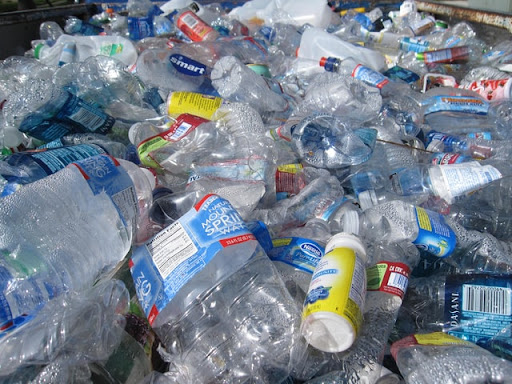
    Plastics are one of the most useful and resilient materials in the world, which is why they are extensively used in various household products. However, their impressive durability is as much of a curse as it is a blessing. When thrown out, plastics can take years to decompose. A plastic water bottle, for instance, may take 450 years to decompose, and a plastic toothbrush could take even longer – up to half a millennium (WWF)! With the current rate at which plastics are being produced, it’s no wonder why scientists and environmentalists are worried about the effect this rapid production will have on the environment. Now, the race is on to find a way to efficiently reduce plastic waste.

    Image Credit

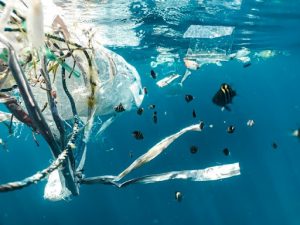
    But why do plastics create such a large problem for the environment? It has to do with the way they’re constructed on a molecular level. Plastics are polymers created when molecular units are linked together, creating “chains” of atoms known as “macromolecules.” Once these macromolecules are formed, they can be extremely difficult to break. Left to the elements, plastics will pollute the environment, taking a large amount of time and effort to chemically break down. At the current rate of production, plastics in the ocean will outweigh all the fish by 2050 (energy.gov).


    One way to combat the plastic crisis is to develop a new material that is able to fulfill the same functions as traditional plastics but also creates less of a strain on the environment. Recently, researchers at the Molecular Foundry at Lawrence Berkeley National Laboratory designed a polymer that can be broken up into its fundamental parts at the molecular level. This means that the material, though it looks and acts just like traditional plastics, can be recycled numerous times without losing performance or aesthetics. Traditional plastics can only be recycled at a rate of 20-30 percent, they don’t retain the same quality once the process is completed. However, this new polymer could turn plastic into a “circular” material which can be recycled endlessly without losing its properties (energy.gov).

    However, this leaves scientists with another question: what do we do with the 8 billion tons of plastic that already exist? Many agree that the answer is to upcycle plastics and turn them into higher-value products like fuels, lubricants, and other materials. Scientists are looking for new ways to convert plastics into other useful materials. One team of multi-institutional researchers discovered a catalytic method of transforming plastics into waxes which can be used in cosmetics, detergents, and other everyday products (anl).

    Image Credit

    The plastic crisis is a large one that will undoubtedly take years of constant and consistent effort to solve. The sheer amount of plastic that currently exists in our oceans and landfills is enough to make one’s head spin. One thing is for sure: major changes must be made in how we deal with plastic production and disposal. But with new recycling techniques and improvements in recyclable plastics, the future looks bright for a cleaner and less-polluted Earth.

    Written by: Matthew Jenkins

    Date: April 24, 2022

    Source:

    1. https://www.wwf.org.au/news/blogs/the-lifecycle-of-plastics

    2. https://www.energy.gov/science/articles/transforming-plastics-recycling-discovery-science

    3. https://www.anl.gov/article/rethinking-the-science-of-plastic-recycling

  • A Comprehensive Guide to Parametric Equations

    A Comprehensive Guide to Parametric Equations

    In mathematics, parametric equations describe a pair of quantities as explicit functions of independent variables regarded as “parameters.” They are most commonly used to define the coordinates of points that comprise a geometric artifact such as a curve or surface, in which case the equations are referred to as a “parametric representation” or “parameterization of an object.” In this article, we will learn to graph plane curves and eliminate the parameter.

    Although, before all else, we will consider the empirical use of parametric equations in order to gain a conceptual understanding of it outside of purely abstract notions.

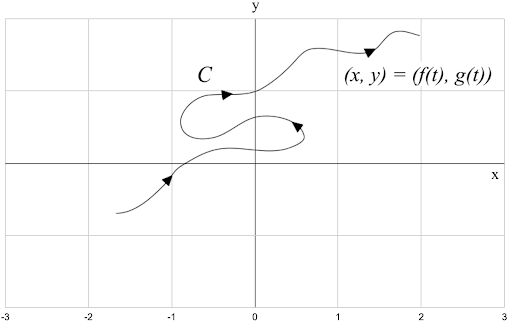
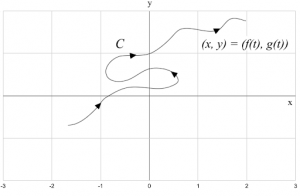
    Imagine a particle moving along a curve C, shown below.

    Image Credit-Estefania Olaiz

    It is virtually impossible to describe C with an equation in the form of y = f(x). This is because it fails the Vertical Line Test, which allows us to determine whether a curve in a graph represents a function. However, the x and y coordinates of the particle are considered functions of time. Therefore, we can consider it as x = f(t) and y = g(t). This should give you a practical idea of our topic of discussion.

    Graphing plane curves

    Graphing a plane curve involves plotting points in the rectangular coordinate system and connecting them with a smooth curve. To do this, we need to select values for t on a given interval, use the given parametric equations to calculate x and y for each value of t, and plot (x, y) in increasing order, as well as connect them with the smooth curve.

    Example: Graph the plane curve defined by the parametric equations x = t² – 1, y = 2t, and -2 ≤ t ≤ 2

    Step 1.  Select values from the given interval. We will now choose integral values of t on the interval -2 ≤ t ≤ 2. Let t = -2, -1, 0, 1, and 2.

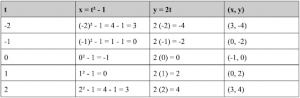
    Step 2.  For each value of t, use the listed parametric equations to calculate x and y. This is demonstrated by the table below, where the first column details the choices for parameter t, the following two columns depict the values for x and y, and the last column delineates the ordered pair (x, y).

    Image Credit-Estefania Olaiz

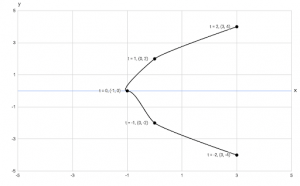
    Step 3. Plot the points (x, y) in order of increasing t and adjoin them with a smooth curve. The plane curve defined by the parametric equations on the interval is loosely represented below.

    Image Credit-Estefania Olaiz

    Note: The line is meant to be smoothed. 

    Eliminating the parameter

    The aforementioned graph shows x = t² – 1, y = 2t, -2 ≤ t ≤ 2. Even if we carefully scrutinize the equations, we may not be able to identify that a corresponding plane curve is a section of the parabola. By removing the parameter, we can create an equation that is equivalent to the parametric equations. To do this, we need to solve one equation for parameter t and substitute the value in the second equation.

    Example: x = t² – 1 and y = 2t.

    Step 1. Solve for parameter t.

    Solving for y = 2t, we get a result of t = y/2.

    Step 2. Substitute for t.

    Using the value t = y/2 and the equation x = t² – 1, we substitute. Therefore, we end up with x = (y/2)² – 1.

    In conclusion, we have just learned how to graph and eliminate parametric equations. A comprehensive approach to the subject will prove itself particularly relevant in a calculus class, more specifically, in an AP Calculus BC course.


    Written By: Estefania Olaiz

    Date: February 28, 2022

    Sources:

    1. https://www.britannica.com/science/parametric-equation

    2. https://en.wikipedia.org/wiki/Parametric_equation

    3. https://tutorial.math.lamar.edu/classes/calcii/parametriceqn.aspx

    4. http://rfrith.uaa.alaska.edu/M201/Chapter10/Chap10_Sec1.pdf 

    5. https://fl01000126.schoolwires.net/cms/lib/FL01000126/Centricity/Domain/261/Ch9_Section5.pdf

  • An Algebraic and Geometric Approach to Eigenvalues and Eigenvectors

    An Algebraic and Geometric Approach to Eigenvalues and Eigenvectors

    In linear algebra, we are introduced to eigenvectors and eigenvalues. While eigenvectors are vectors with a direction immutable by a transformation, eigenvalues are associated with the physical quantity by which the eigenvector is scaled. 

    For the average student, most of these concepts can be difficult to grasp from a geometric perspective. That is why, in the following sections, I will utilize visual representations in addition to manipulating symbols algebraically. 

    The fundamental formula that characterizes the eigenvectors and eigenvalues of a matrix is Av = λv. In which A is a matrix, v is an eigenvector, λ (lambda) is an eigenvalue, and v is an eigenvector.

    Let’s begin by considering the given 2×2 matrix.

     [ 2, 3

          5, 4 ]

    Where our eigenvectors are:

    [ 3      and      [ -1

        5 ]                   1 ] 

    With corresponding eigenvalues of λ1 = 7 and λ2 = -1.

    To arrive at these conclusions, our first step consists of subtracting λ from the diagonal entries, much like this:

    [ 2 – λ, 3

          5, 4 – λ  ]

    Wherefore the characteristic equation, or determinant, of our matrix, is:

    (λ – 7) (λ +1) = 0

    We end up with λ1 = 7 and λ2 = -1 as our eigenvalues. Now, we will input the different values of λ into our previous equation.

    [ 2 – 7, 3     =    [ -5, 3 

         5, 4 – 7  ]           5, -3 ]

    And

    [ 2 – -1, 3     =    [ 3, 3 

        5, 4 – -1  ]          5, 5 ]

    Where the null spaces of our matrix, found by satisfying the equation Ax = 0, are:

    λ1 = {[ 3

                    5 ]}

    And

    λ2 = {[ -1

                     1 ]}

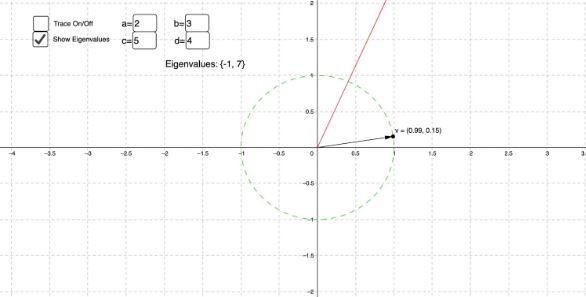
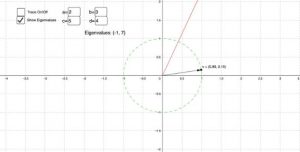
    This is how we reach the aforementioned solutions. On another note, a visual that can accurately represent our conclusion would be the following:

    Image source

    Hopefully, with this brief overview, you’ve been able to gain some confidence in your ability to calculate and visualize eigenvectors and eigenvalues from an algebraic and geometric point of view.

    By: Estefania Olaiz

    March 19, 2022

    Sources:

    1. https://en.wikipedia.org/wiki/Eigenvalues_and_eigenvectors#:~:text=Geometrically%2C%20an%20eigenvector%2C%20corresponding%20to,negative%2C%20the%20direction%20is%20reversed.
    2. https://www.mathsisfun.com/algebra/eigenvalue.html 
    3. https://lpsa.swarthmore.edu/MtrxVibe/EigMat/MatrixEigen.html
    4. https://www.mathsisfun.com/algebra/matrix-determinant.html 
    5. https://www.geogebra.org/m/JP2XZpzV