Author: Eric Magers

  • Benefits Of Inquiry-Based Learning For Middle-Schoolers

    Benefits Of Inquiry-Based Learning For Middle-Schoolers

    To understand how inquiry-based learning is beneficial to students, it’s important to have a clear idea of what it means. Put simply, inquiry-based learning is an approach that emphasizes the student’s role in the learning process. Instead of the teacher telling the students what they need to know, students are encouraged to explore the material, share ideas, and ask questions. There are several different approaches to this kind of learning which include small group discussion, guided learning, and individual exploration. The objective is to get students to learn by doing as opposed to memorization which results in limited retention.

    Skills
    Students will build the foundations of incredibly important skills that will help them in the future through inquiry-based learning. As they explore certain topics, students will absorb communication and critical thinking skills. These cognitive skills not only help students understand the particular concept they’re working on, but it also helps them improve comprehension in almost every subject and their daily lives. Skills such as these are also very important for the future because both communication and critical thinking will help with solving problems and collaborating with others.

    Engagement
    One of the advantages of inquiry-based learning is that it actively engages students so they aren’t just hearing or writing what they’re being taught. They have the opportunity to explore a topic in-depth and learn from firsthand experience if possible. This allows students to better understand and recall the material they’re learning because they’re able to make their own connections. It’s been proven that we retain 75% of what we do compared to 5% of what we hear and 10% of what we see.

    Style of Learning
    Another way that inquiry-based learning is beneficial is that it allows students to take ownership of their learning since they will explore topics on their own. This will allow them to process the material in a way that works best for them rather than relying on the single way that the teacher explains it. As a result, they will be more inclined to learn the information because it will be their responsibility. They will also take initiative by making their own connections and drawing their own conclusions. By pursuing a way of learning that is comfortable to them, the students will have a much greater chance of actually wanting to learn the information.

    Creating a Love of Learning
    When students have the opportunity to approach learning through the inquiry-based method, it allows them to connect with the information on a deeper level. This helps students gain an understanding of the material they’re learning. Inquiry-based learning is also designed to teach students how to develop a passion for learning and exploration. Since they’re the ones personally processing the information, they will be more likely to understand what they’re learning, appreciate the knowledge they’re gaining, and understand the value of what they learn in school.
    In conclusion, inquiry-based learning has various benefits that can truly help middle school students understand concepts and what they’re learning better. Additionally, it will lay the groundwork for their future. It helps them to develop important skills and foster engagement.. It’s also an approach to learning that will be incredibly useful when these students go off to high school and college where they will play more of an active role in their education. Overall, it’s highly beneficial for middle schoolers and will help them reach their full potential as learners.

     Written by Anumita Basani

    October 25, 2021
    Your NSTEM Journey Begins Here!

  • Winged Microchip is Smallest-ever Human-made Flying Structure

    Winged Microchip is Smallest-ever Human-made Flying Structure

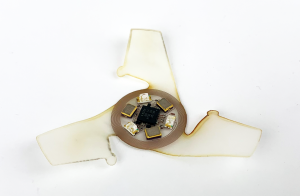
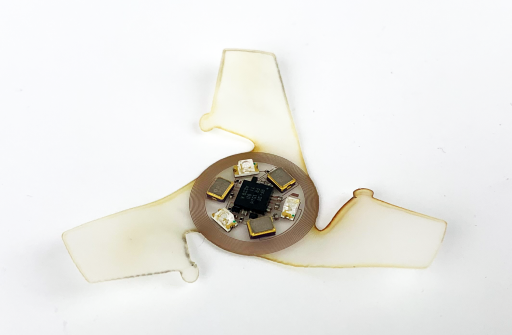
    Northwestern University engineers announced the newest capability of microchips: the ability to fly. The microflier is a grain-of-sand-sized microchip with propellers that are guided by the wind. With this new technology, scientists will be able to, “monitor for contamination, surveil populations or even track diseases.”

    The microflier has two parts: electronic components and wings. This makes the microchip low in weight to help prevent it from losing control and chaotically tumbling to the ground. According to the press release, the microflier offers different forms of data collection including: “sensors, a power source that can harvest ambient energy, memory storage and an antenna that can wirelessly transfer data.” It can be made available in various shapes and sizes to accommodate a wide variety of locations. Rogers believes that devices could be mass-dropped from the sky around various locations to “monitor environmental remediation efforts after an oil spill, or to track levels of air pollution at different altitudes.”  

    winged microchip
    A Winged Microchip

    Our goal was to add winged flight to small-scale electronic systems, with the idea that these capabilities would allow us to distribute highly functional, miniaturized electronic devices to sense the environment for contamination monitoring, population surveillance or disease tracking,”said Northwestern’s John A. Rogers. To achieve this goal, the Northwestern research team studied the aerodynamics of a number of plants’ seeds and more specifically the aerodynamics of ​​the wings on a tristellateia seed. This is because tristellateia seeds have bladed wings that make them land in different areas every time. Through trial and error, researchers tested every aspect of these devices based on their seed research from airflow simulation to redesign of the device itself. Eventually, researchers began finding the perfect qualities that allowed the microflier to propagate larger areas efficiently. Propagating is the process of naturally dispersing seeds in order to increase the amount of plants. In this case, propagating is for surveying a large area more efficiently. 

    Winged Microchips Concept
    Concept Winged Microchips

    In order to combat further pollution of the Earth, Northwestern engineers are developing a version of microfliers that are able to dissolve in water.  Right now, the main obstacle is that a majority of these devices may need to be in circulation to keep up with the amount at risk to hit the water. 

    To learn more about Microfliers and the progress Northwestern researchers are making, check out Northwestern’s press release.

    Written By: Kathryn Cottingham
    October 6, 2021

    Sources:

    Your NSTEM Journey Begins Here!

  • NASA Shells Out Contracts In September

    In September,  the National Aeronautics and Space Administration (NASA) announced a number of suitors for space mission contracts. The US government is the single largest investor in the space industry but cannot conduct all operations on its own. To manage their workload NASA issues contracts to smaller companies. They compete against each other for these contracts as a means to turn a profit and earn a positive reputation both within the space community and outside potential investors. These contracts can vary widely both in terms of monetary value and responsibilities. 

    Most recently, NASA awarded Aerojet Rocketdyne Inc. with a 600 million-dollar contract to build new engines for their Orion spacecraft. The new engines will replace the old engines and will integrate with all the systems aboard the Orion spacecraft. The contract is not exclusive to engines for the Orion spacecraft but other rocket building projects as well, should NASA find their work satisfactory. NASA has outlined the contract to begin September 21st, 2021 and end on April 23rd, 2032.

    NASA has also awarded $146 million to five different companies to troubleshoot, plan, and execute the Artemis space program which intends to put people on the moon once again, according to NASA’s procurement report. This manned mission requires outside help in the planning and management of the project, hence the contract. These companies will have such tasks as new lander concepts and risk management over the next 15 months.

    The five companies include:

    • Blue Origin Federation of Kent, Washington, $25.6 million. 
    • Dynetics (a Leidos company) of Huntsville, Alabama, $40.8 million.
    • Lockheed Martin of Littleton, Colorado, $35.2 million.
    • Northrop Grumman of Dulles, Virginia, $34.8 million.
    • SpaceX of Hawthorne, California, $9.4 million.
    rocket blastoff
    Space X Rocket Blasting Off

    Exclusively on the ground, in September NASA awarded nine companies with the responsibility of maintaining, modernizing, and developing infrastructure. With a total of $300 million, NASA needs these companies to create tailored buildings, facilities, and systems at all of their working sites around the world. Proper architectural maintenance of facilities and civil structures along with constant updates for ground support systems are some of the crucial responsibilities these companies will bear under contract. 

    The nine companies include:

    • AECOM Technical Services Inc. of Orlando, Florida
    • BPRH Architects-Engineers Inc. of Melbourne, Florida
    • Jacobs of Arlington, Virginia
    • The Johnson-McAdams Firm P.A. of Greenwood, Mississippi
    • Jones Edmunds & Associates Inc. of Titusville, Florida
    • Merrick & Company of Greenwood Village, Colorado
    • Nelson Engineering Company of Merritt Island, Florida
    • RS&H Inc. of Merritt Island, Florida
    • TransSystem and GHD Inc. AF JV of Berkeley, California

    NASA has also awarded a $8.4 million contract to Panamerica Computers of Luray, Virginia. Over the next three years, NASA will call on Panamerica Computers for oversight on the development of new software as they are needed and technical support on all their networks and computer systems.

    Earth from Space
    Picture Courtesy of NASA

    Another large contract in the month of September was to Space Exploration Technologies (SpaceX) of Hawthorne, California, worth $152.5 million. SpaceX will be responsible for launch services of the GOES-U mission organised by NASA. The GOES-U mission is a collection of stationary weather monitoring satellites designed to record weather data and climate change. 

    With so many contracts being awarded by NASA, more opportunities for space exploration are being developed that can lead to breakthroughs in technology or discovery. It is also an indication that the US government plans to continue to support space exploration and the space industry will grow to include more companies and workers in the field.

    Written by: Alexander Jones

    October 6th 2021

    Resources: 

    Your NSTEM Journey Begins Here!

  • Unique STEM Homework Assignments for Elementary School Students

    Unique STEM Homework Assignments for Elementary School Students

    Are you an elementary school teacher looking for ways to integrate STEM into your classroom without using the same worksheets? Then this article is for you! Below are five unique homework assignments elementary school students can do to foster  their STEM interests. 

    Photo by Mike Fox
    1. Recycled Monsters!

    This activity serves as a great way for students to improve their motor skills while being creative and learning about recycling.

    Grades: K-3

    Materials Needed: Recycled Materials (Cardboard, Water Bottles, 2L Bottles, etc.), Googly Eyes, Markers, Chenille Pipe Cleaners, Construction Paper

    Instructions: 

    • A few days before the activity, have your students bring recyclable materials from their home (that’s the homework assignment!).
    • Once all materials have been collected, prepare for the activity by dividing your classroom into three stations.
    • The first station will have all of the recycled materials; this is where the students will choose the body of their monster. 
    • The second station will have glue, scissors, and construction paper.
    • Once students have created their monsters, they can move to the third station containing the googly eyes and markers. 
    • All that’s left to do is for students to decorate their monsters and bring them to life!
    1. The Five Senses 

    This activity will take your lesson into the real world! Students will be able to use their five senses and share them with the class. 

    Grades: K-3

    Materials Needed: N/A

    Instructions:

    • Have students write down 5 things they can see, hear, touch, smell, and taste at home. 
    • To make it more fun for the students, ask them to bring in one of these objects.
    • Have a show and tell!
    1. Code.org®
    Photo by Compare Fibre

    Code.org® is a free online coding tool focused on expanding access to computer science. You can sign up as an elementary school teacher and assign their suggested activities to students. Since Code.org is for all ages, it would be beneficial to encourage students to make their accounts to continue learning about computer science throughout their educational career.

    Grades: K-12

    Materials Needed: Computer/Laptop, WiFi

    Instructions: Up to you!

    1. Math Playground

    Are your students tired of the same boring math homework? Then try Math Playground

    Math Playground is a free online tool for first to sixth-grade students aimed at making math fun for kids. You can choose the grade you teach and have students play a specific game as homework.

    Grades: 1-6

    Materials Needed: Computer/Laptop, WiFi

    Instructions: Up to you, but here’s a suggestion.

    • Choose your grade(s) on the home screen and pick a game that aligns with your lesson plan.
    • Have students get to a certain level of difficulty and discuss it more in-depth during class.
    • To log their progress, have students fill up a chart.
    1. My Favorite Animal 

    An easy way to integrate tech into the classroom is by having kids record themselves talking about their favorite animal and show it to the class.

    Grades: K-5

    Materials Needed: Computer/Laptop/Tablet/Phone, WiFi

    Instructions:

    • Have students pick an animal in class to make sure there are no repeats. 
    • They should sit in front of a camera and talk about their favorite animal.
    • To make it more challenging, give them a time limit and ask them to use a single special effect (slow motion, add pictures, add a title, put music in the background, etc.).

    Written By: Isamarie Hernandez Arroyo, NSTEM PR

    Your NSTEM Journey Begins Here!

  • Common STEM Themes to Include in Your Lesson

    Common STEM Themes to Include in Your Lesson

    Are you curious about how to create a better lesson plan for your STEM students? There are certain characteristics and themes you want to include in your lesson that will keep students engaged. Additionally, it is important to include these themes because it will help your students learn STEM material more effectively. 

    Image Credits

    Focus on Real-World Material

    Some of your lessons may include an example, problem, or project about a real-world issue. A real-world STEM problem will help to engage students who might have been previously disinterested. This is because students will be able to see how STEM affects the world around them. Also, real-world examples in STEM may be able to help students conceptualize the content better. By connecting STEM to the real-world around them, students will be able to understand the material better. 

    Teamwork

    If you are teaching your students STEM, you will want to include teamwork in your lesson plan. Teamwork is an essential skill that any student should learn. Especially in STEM, students will be working on teams all the time in labs, doing research, or working on projects. By incorporating teamwork into your lesson plan, your students will be able to adopt this skill. This will allow your students to learn how to work together and figure out STEM-related problems with each other. 

    Use the Engineer Design Process

    Most STEM lesson plans will include the Engineer Design Process. The Engineer Design Process can be used to help students solve problems and find solutions. When encountering a STEM problem, students can use this process to define and research it, find many possible solutions, and develop and test them. When including this process in your lesson plan, students will evaluate a problem, find multiple solutions, and learn how to improve. 

    Hands-on Material

    In your STEM lesson, students should be working on hands-on material. Students can work hands-on with material by researching, designing, building, or creating something relevant to the concept they are learning. When students work hands-on, they are more likely to be focused on the material and retain the information better. 

    Image Credits

    Include Relevant Math and Science Material 

    Your lesson plan should incorporate grade-appropriate math and science concepts together. Math and science are interconnected, so students must see this connection early on. Higher-level STEM subjects like Physics and Engineering are heavily connected with math and science. This is why students should be learning about how these two subjects are intertwined through their lessons. 

    Looking for more ways to better teach your students about STEM and keep them engaged? Visit NSTEM’s website for more information: https://nstem.org/staging/ 

    Written by Meghan Latham

    August 18th, 2021


    Your NSTEM Journey Begins Here!

  • Do You Want to Be a Future Engineer? Read This for Tips!

    Do You Want to Be a Future Engineer? Read This for Tips!

    Do you want to be an engineer when you grow up? Do you want to build and fix things when you grow up? If so, there is a good chance that you want to be a future engineer. There are plenty of opportunities for students who want to be engineers when they grow up. The National STEM Honor Society is here to provide you with tips to be a future engineer. 

    Image Credits

         1. Build communication skills

    It is important to build these skills to form relationships with others and to understand their ideas. Engineers need to be able to communicate their ideas with others and to relate with others when working on projects. This is especially important for when the project is being discussed with the supervisor or another lead on the project as engineers need to be able to articulate their ideas. Be aware of your audience, whether it’s a board of executives or a crowd at a convention.

         2. Participate in different challenges for engineers

    There are multiple organizations and companies that are putting their resources into developing young students who are interested in engineering. An organization called Future Engineers has different projects to challenge students, especially if they are interested in engineering. Students can enter these competitions and other events that different organizations or companies may have to challenge themselves and to see if they have any other opportunities like a scholarship or possibly an internship.

         3. Take up another area of study along with engineering

    Students should not only focus on engineering, but have a focus in another area as well. In any field when a person moves up, there are more responsibilities and not all of them may be related to the field of engineering that they are in. Students who have experience in another field will be able to manage and understand other fields if they become a supervisor or have to lead a project that is in collaboration with another field as the student would be a little familiar with the field.

    Image Credits

         4. Gain some experience in the field of engineering that you want

    Students should try to find opportunities to volunteer or intern in the field of engineering that they are interested in. This will allow the students to gain some experience and to see if they like this field of engineering. This will also open doors for students later on when they are looking for jobs after they get their degree.

         5. Know your material

    The material that students have to know for engineering is important. Students should be able to learn their material to such a level that they should be able to at least recognize when they are on the job. Students should not just learn the material, but also be able to build on that knowledge from the material by learning other things that can be used in their engineering field. 

         6. Ask questions

    There are no dumb questions, especially when trying to find a solution. Do not get discouraged that everyone else may be ahead in  an area. It is also good to ask questions, especially if you are curious about something or if you are naturally curious about something.

    Written By: Lee Metoyer

    Your NSTEM Journey Begins Here!