
Author: NSTEM Media

  • Snowflakes and Science: 3 Activities Exploring the Unique Patterns

    Snowflakes and Science: 3 Activities Exploring the Unique Patterns

    Photo Courtesy of Pixabay

    As winter blankets the world in a glistening layer of snow, there is an opportunity to turn this season into an educational adventure for elementary school students. We will embark on a journey through the delicate and enchanting world of snowflakes. These unique ice crystals bring joy to snowy landscapes and serve as fascinating scientific exploration subjects. We have found three engaging websites, each offering snowflake science lessons and activities tailored specifically for students in grades 3-5. From the intricate formations to the historical significance of snowflake photography, these resources promise to make learning about the science of snowflakes an unforgettable experience. So, let’s dive into the wonders of winter, where science meets the magic of snow, and discover the captivating world of snowflake STEM activities for young minds.

    1. SnowCrystals.com – Snowflake Science Lessons

    • Significance: SnowCrystals.com, run by physicist Dr. Kenneth G. Libbrecht, is a fantastic resource for snowflake science. This site provides detailed lessons on the science behind snowflakes, including their formation and unique crystalline structures.
    • How it Works: This website offers engaging and interactive lessons suitable for elementary school students. It includes visually appealing diagrams and videos that simplify complex concepts, making it easy for young learners to grasp the science of snowflakes.
    • What it Teaches: Students will learn about the physics and chemistry involved in the formation of snowflakes. The lessons cover water vapor, temperature, and crystal growth topics. Additionally, hands-on activities allow students to create paper snowflakes, reinforcing the scientific principles they have learned.

    2. National Geographic Kids – Snowflake Science

    • Significance: National Geographic Kids is a reputable source known for its educational content. The snowflake science section provides a kid-friendly approach to understanding the science behind these delicate ice crystals.
    • How it Works: This website offers interactive games, videos, and articles that make learning about snowflakes engaging and entertaining. The content is designed specifically for elementary school students, ensuring it aligns with their comprehension levels.
    • What it Teaches: Students will explore snowflakes’ unique characteristics, the snow formation science, and the various types of snow crystals. The interactive elements make learning a fun and memorable experience.

    3. STEM Activities for Kids – Snowflake Bentley Lesson

    • Significance: STEM Activities for Kids provides a lesson inspired by Wilson Bentley, known as “Snowflake Bentley,” the first person to photograph snowflakes. This lesson combines history with hands-on science.
    • How it Works: This lesson plan guides students through the life and contributions of Snowflake Bentley, followed by an activity where they can create their snowflake art using basic materials.
    • What it Teaches: In addition to learning about the science of snowflakes, this activity introduces students to the historical aspect of snowflake photography. It encourages creativity and artistic expression while reinforcing scientific concepts.

    In conclusion, exploring the science of snowflakes through these three engaging activities can spark a festive interest in STEM for grades 3-5 students. NSTEM, with its vast resources and community, complements these activities by providing a platform for students and educators to explore STEM subjects further. To delve deeper into STEM and inspire young minds, consider starting an NSTEM chapter at your school. The National STEM Honor Society offers a supportive community, resources, and opportunities for students passionate about science, technology, engineering, and mathematics.

    By Srihitha Sunkara

    Do you want more resources on the topic of the science of snowflakes? NSTEM’s vast resources database provides thousands of STEM resources that are searchable by category, school level, and state. This comprehensive library includes info on enrichment activities, curricula, internships, scholarships, and more. Check out a free sampling here. Or get an NSTEM membership today to unlock the complete list.

    Grades 3-5 continue the STEM education journey, where students are interested in the natural world, in how things work, responding to stories told by teachers that give purpose and meaning to STEM disciplines, which molds them into thinkers, problem solvers, and creators. The National STEM Honor Society sees grades 3-5 as a critical point in the NSTEM journey. To start your grade 3-5 chapter of the National STEM Honor Society, click here.


  • Circuit Claus: Lighting Up the Holidays with 3 Technology Activities

    Circuit Claus: Lighting Up the Holidays with 3 Technology Activities

    Photo courtesy of Pixabay

    Sparkling lights and circuitry are bringing a technological twist to this holiday season for elementary schoolers! As the holiday season approaches, students can engage in holiday cheer while meeting the thrill of hands-on learning with technology. You might wonder what we mean, so we will simplify it. Here are three festive circuit activities for teachers to captivate students this season.

    1. Holiday Lights Circuitry

    In this activity, students create a circuit to light up multiple cuttings of holiday light strings atop a sheet of cardstock. A battery powers the circuit, and aluminum foil and brass fasteners connect the electricity to the holiday lights’ wires. This project teaches students about the flow of electricity and the multiple aspects of a circuit, including the power source, connectors, and load. You can also use this activity in lessons regarding closed and open circuits. You can alter this project to teach students about various circuits, both simple and complex.

    Activity link: https://ashevillescience.org/wp-content/uploads/2020/03/Holiday-Light-Circuitry.pdf

    Materials needed: cardstock, aluminum foil, tape, Christmas lights, a 9v battery, and scissors.


    2. Holiday Card Circuits

    In this activity, students make a holiday card with an LED light-up feature on the cover. A flat battery connects to aluminum foil on the inside of the card to power a small LED sticking out of the front cover. To make this activity festive, your students can place the outer light in a holiday drawing, such as Rudolph’s nose or a light-up star atop a Christmas tree. This project teaches students about electric currents and how a power source can be connected to a load with something as simple as aluminum foil.

    Activity link: https://www.kiwico.com/diy/holiday-events/winter-break/holiday-card-circuits

    Materials needed: cardstock, 3v coin cell batteries, aluminum foil, LEDs, tape, glue, and markers.


    3. Christmas Lime Battery

    In this activity, students create a Christmas tree-shaped project with a light-up star at the top. Copper wire is connected to limes with nails to use the electricity found in the citrus fruit. Using the power from the limes, the LED bulb lights up. Students can also decorate the structure with pipe cleaners or other materials. This project teaches students about the conductive properties of ions found in acids and, therefore, acidic fruits. It also teaches students how to connect a circuit and use a power source to light an LED.

    Important: Although the following activity guide link suggests using this activity for young children, we recommend it for students in grades 3-5.

    Activity link: https://www.preschoolplayandlearn.com/christmas-lime-battery-electricity-experiment-for-preschoolers/

    Materials needed: six limes, six nails, heavy copper wire, wire cutters, LEDs, and electrical tape.


    With these three activities, you can engage your students in holiday activities to introduce them to electrical circuitry. Implement them in your lessons or daily activities, and students will indeed have something new to learn and enjoy!

    By Tyler King

    Do you want more resources on the topic of festive circuit activities? NSTEM’s vast resources database provides thousands of searchable STEM resources by category, school level, and state. This comprehensive library includes info on enrichment activities, curricula, internships, scholarships, and more. Check out a free sampling here. Or get an NSTEM membership today to unlock the complete list. 

    Grades 3-5 continue the STEM education journey, where students are interested in the natural world and how things work, responding to stories told by teachers that give purpose and meaning to STEM disciplines, which molds them into thinkers, problem solvers, and creators. The National STEM Honor Society sees grades 3-5 as a critical point in the NSTEM journey. To start your grade 3-5 chapter of the National STEM Honor Society, click here.

  • Math Mysteries Unveiled: 4 Fun and Interactive Math Games for Elementary Grades

    Math Mysteries Unveiled: 4 Fun and Interactive Math Games for Elementary Grades

    Photo Courtesy of www.the74million.org

    Are you on the lookout for engaging math games to captivate your elementary school students? Fortunately, many math games promise enjoyment for your students and convey valuable math lessons. With these games, you can capture your students’ attention while delivering essential mathematical concepts. Here are four fun and interactive math games for elementary grades.

    1. Addition and Subtraction Bingo

    Begin by preparing bingo cards and jotting down answers to simple addition and subtraction problems. Distribute these cards to your students. When you call out a number during the game, read the corresponding math equation. For example, if you say “14 – 5,” whoever circles “9” on their bingo card earns a point. Continue until someone achieves bingo and wins the game. This game promotes quick thinking and enhances addition and subtraction skills.


    2. Math Twister

    Create a Twister mat and label each color with a number instead. Call out equations while your students locate the solution on the mat. For instance, instead of saying “right hand on the green,” you would say “left foot on 9 x 5,” and students would find the number 45. This game introduces the world of multiplication and division in a high-tension, enjoyable setting, challenging students to apply their skills.


    3. Hot Potato

    Take a plastic ball (or an actual potato) and tape various math questions onto it. Form a circle with your students and pass the “hot potato” while music plays. The student holding the ball must answer a question when the music stops. Correct answers keep them in the game, while incorrect answers result in elimination. This game encourages quick thinking and adds an element of fun to math challenges.


    4. Math Jeopardy

    Bring the classic game show “Jeopardy” into your classroom by creating your own Jeopardy board with categories and point values. Use diverse categories like multiplication, fractions, graphing, long division, and basic geometry. Split your class into two teams, allowing them to pick cards and earn or lose points based on their answers. This adaptation of a familiar game show makes learning math an engaging and competitive experience.


    These are a few examples of the interactive math games your elementary school students can enjoy. These games enhance their mathematical skills and make learning a dynamic and enjoyable experience. For additional resources on fun and interactive math games for elementary students, explore NSTEM’s vast database, which provides thousands of STEM resources searchable by category, school level, and state.

    By Rameen Naviwala

    Do you want more resources on the topic of math games for elementary students? NSTEM’s vast resources database provides thousands of searchable STEM resources by category, school level, and state. This comprehensive library includes info on enrichment activities, curricula, internships, scholarships, and more. Check out a free sampling here. Or get an NSTEM membership today to unlock the complete list. 

    Grades 3-5 continue the STEM education journey, where students are interested in the natural world and in how things work, responding to stories told by teachers that give purpose and meaning to STEM disciplines, which molds them into thinkers, problem solvers, and creators. The National STEM Honor Society sees grades 3-5 as a critical point in the NSTEM journey. To start your grade 3-5 chapter of the National STEM Honor Society, click here.

  • Math Magic: 5 Free Resources for Mastering College Mathematics

    Math Magic: 5 Free Resources for Mastering College Mathematics

    By Rameen Naviwala

    Photo Courtesy of Shutterstock

    Are you looking for free college resources to help you get more practice in your math courses? Or to learn different mathematical subjects in your free time? Look no further for helpful and free resources to help you master mathematics. College and life after high school are hectic periods where you can often be strapped for time and cash. So, finding helpful and free resources to broaden your math knowledge is paramount. Here are five free outstanding math resources for college/university students.

    1. Khan Academy

    One of the most common and well-known math websites you can use for free is Khan Academy. Ranging from introductory algebra to advanced calculus, this website has it all. From workbooks to videos explaining each problem and to practice tests, there are plenty of advantages to using Khan Academy. You can reinforce what you learn in your lectures through their activities and venture into new territories by watching video lessons explaining new math concepts.


    2. WolframAlpha

    WolframAlpha is an incredible resource for calculus, number theory, complex analysis, and applied mathematics. This website covers all advanced topics you may learn in college courses and topics you should understand to advance your STEM career. It gives you various questions and issues at each math level. Furthermore, offering step-by-step instructions, Wolfram Alpha can help you navigate homework or assignments you might struggle with.


    3. Zona Land Education 

    Through entertaining and educational activities, Zona Land Education teaches you physics, the mathematical sciences, and general mathematics. It gives you step-by-step instructions and in-depth lessons for different subjects that allow you to learn as much as possible regarding college-level math. This website is highly recommended and very educational, enabling you to get extra practice between your lectures and assignments.


    4. PBS Infinite Series

    PBS Infinite Series is a mini web series that teaches complex math through storytelling. Mathematician Kelsey Houston-Edwards offers ambitious content for college students aiming to learn more about mathematics and how the world around them uses these topics to function. Each episode portrays how math exists within all aspects of this strange and puzzling world. This website is the perfect tool if you prefer watching engaging videos instead of practicing worksheets and lectures.


    5. Hausdorff Center for Mathematics

    This YouTube channel covers a range of different and advanced topics with varying lecturers and professors. The Hausdorff Center for Mathematics (HCM) is a cluster of excellence for mathematical research and mathematical economics at the University of Bonn. This resource is a great way to learn about different topics through lectures and videos that thoroughly explain each subject covered in the videos. Videos are also recorded as college lectures, evoking a familiar learning feeling.


    Explore these five free math resources for college – they are NSTEM-approved and ready to assist you throughout your college journey. Finding reliable and free tools can be tricky, but these websites are here to support you!

    Do you want more resources on the topic of free college math resources? NSTEM’s vast resources database provides thousands of searchable STEM resources by category, school level, and state. This comprehensive library includes info on enrichment activities, curricula, internships, scholarships, and more. Check out a free sampling here. Or get an NSTEM membership today to unlock the complete list. 

    When a college/university student achieves membership in the National STEM Honor Society, the recognition, like many colleges, is in a Greek letter format.  For the National STEM Honor Society, Epsilon Theta Mu is the designated recognition for members at the college/university level. Students are distinguished and stand out due to this recognition, increasing appealing employment and educational opportunities, click here.

  • Climate Change and 7 Careers in STEM: Inspiring the Next Generation

    Climate Change and 7 Careers in STEM: Inspiring the Next Generation

    Photo Courtesy of stemfellowship.org

    Are you ready to embark on an exciting journey into the world of STEM (Science, Technology, Engineering, and Mathematics) and learn how you can make a real difference in the fight against climate change? Climate change is one of the most critical challenges facing our planet today. But did you know that there are exciting career opportunities in STEM fields that can help make a positive impact on our environment? If you’re curious about how to make a difference while having an exciting career, here are seven excellent STEM career paths you can explore!

    1. Climate Scientist

    • What They Do: Climate scientists study the Earth’s climate and how it’s changing. They analyze data, research, and develop models to understand the causes and effects of climate change. They investigate weather patterns, predict natural disasters, and explore how human activities affect the environment.
    • How to Prepare: Start by getting excited about science and math! Learn about weather patterns, ecosystems, and the atmosphere. Take science classes and participate in environmental clubs to explore your interests. You can study meteorology, environmental science, or even physics as you grow.
    • Average Yearly Salary: $122,296

    2. Renewable Energy Engineer

    • What They Do: Renewable energy engineers are like the superheroes of clean energy. These engineers design and create renewable energy sources like solar panels, wind turbines, and biofuels. They work to develop sustainable ways to power our world without harming the environment.
    • How to Prepare: Begin by exploring the world of renewable energy. Learn about solar power, wind energy, and hydropower. When you’re older, focus on math and science, especially physics. Get involved in school energy-related projects and explore how things work, like experimenting with solar-powered gadgets.
    • Average Yearly Salary: $89,941

    3. Environmental Engineer

    • What They Do: Environmental engineers solve environmental problems, like pollution and waste management. They develop solutions to purify water, manage waste, and create sustainable systems for cities and industries.
    • How to Prepare: Start by exploring environmental issues in your community. Learn about recycling, pollution, and waste management. When you’re older, consider studying ecological engineering to become a problem solver. Get involved in projects that help your community or school go green!
    • Average Yearly Salary: $96,530

    4. Sustainability Specialist

    • What They Do: Sustainability specialists work to create a balance between meeting our needs today without compromising the ability of future generations to meet their needs. They help organizations reduce their environmental impact.
    • How to Prepare: Explore ways to make a difference in your community by conserving resources. Learn about sustainable practices, such as reducing, reusing, and recycling.
    • Average Yearly Salary: $122,624

    5. Green Architect

    • What They Do: Green architects design buildings and structures using eco-friendly materials and techniques. They focus on creating sustainable and energy-efficient spaces.
    • How to Prepare: Love design and construction? Study math, art, and science. Try creating models or designs using recyclable materials or energy-efficient structures.
    • Average Yearly Salary: $128,756

    6. Environmental Conservationist 

    • What They Do: Environmental conservationists work to protect and preserve the environment. They help safeguard endangered species, conserve natural resources, and restore damaged ecosystems.
    • How to Prepare: Start by caring for the environment around you. Learn about local wildlife and plants. As you grow, you can study biology, ecology, or environmental science to become an Earth protector.
    • Average Yearly Salary: $64,460

    7. Oceanographer 

    • What They Do: Oceanographers explore the mysterious depths of the ocean. They study marine life, investigate underwater volcanoes, and help us understand how the ocean influences climate.
    • How to Prepare: Dive into books and documentaries about the ocean. Learn about marine animals and ecosystems. Consider studying oceanography, marine biology, or geology as you age.
    • Average Yearly Salary: $75,960

    In conclusion, by pursuing these STEM careers related to climate change, you can become real-life heroes working to protect our planet. The future of our planet is in your hands! As you can see, incredible STEM opportunities directly related to addressing climate change exist. If you’re excited about these careers, consider starting an NSTEM chapter at your school! NSTEM can help you explore these paths and engage in exciting projects related to climate change and STEM. 

    By joining NSTEM, you can participate in hands-on activities, meet experts in these fields, and work on projects that contribute to a healthier planet. Exciting, right? Don’t miss out on these fantastic opportunities to make a difference in the world through STEM! So, what are you waiting for? Get involved and be a part of the solution! Start your NSTEM journey and explore the fantastic world of STEM careers related to climate change!

    By Srihitha Sunkara

    Do you want more resources on the topic of STEM majors and careers? NSTEM’s vast resources database provides thousands of searchable STEM resources by category, school level, and state. This comprehensive library includes info on enrichment activities, curricula, internships, scholarships, and more. Check out a free sampling here. Or get an NSTEM membership today to unlock the complete list. 

    Project-based learning enrichment provides high school students with college and career readiness. It gives them real-world relevance, transforming students into collaborators and imaginative problem solvers. They will gain the upper hand in a global landscape, stemming from enhanced confidence and grit. NSTEM provides these young STEM enthusiasts with a close community of like-minded fellow students and educators. To start your 9-12 Chapter of the National STEM Honor Society, click here.
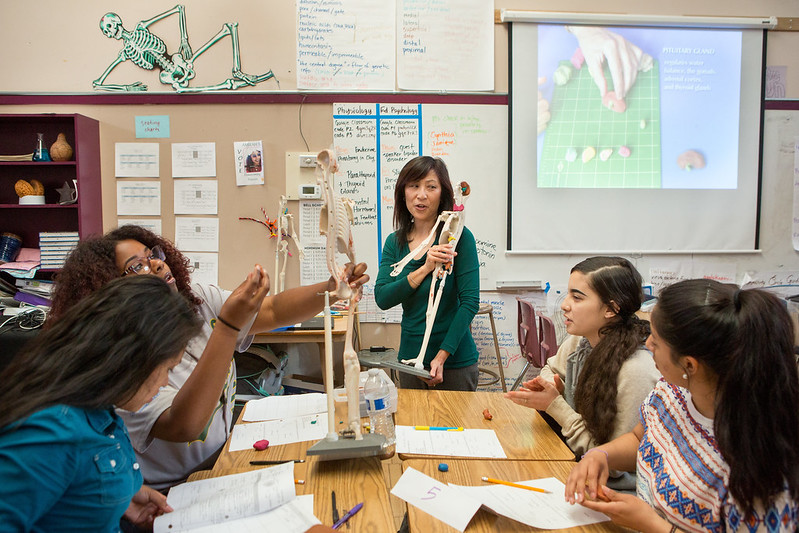
  • The 4 Stellar Ways to Excel as a STEM Teacher!

    The 4 Stellar Ways to Excel as a STEM Teacher!

    Photo Courtesy of Flickr

    Are you a STEM teacher looking for unique ways to teach and educate your high school students that will engage and inspire them all? Having exciting methods and lesson plans can encourage your students to have a more significant interest in STEM and help them have a successful career. As their high school teacher, you must help them reach their potential in their future career. Here are four stellar ways you can excel as a STEM teacher.

    1. Project Based Learning

    Instead of having your students sit down and read textbooks as you lecture them about different concepts, have them apply them. Create projects that imitate real-world issues and have students use the STEM concepts they learn to create a practical solution. This type of learning promotes critical thinking, teamwork, and hands-on learning. Furthermore, it allows students to understand the value of STEM education in the real world and how it can be applied to common problems. Two excellent websites offering high school STEM projects are PBS LearningMedia and TPT.  


    2. Combine Art and STEM

    While most people consider art and STEM opposite sides of the educational and career spectrum, they can be paired together to encourage creativity and interdisciplinary learning. For high school students struggling with STEM, this learning technique can encourage them to take a greater interest in STEM while honing their more creative skills. You can have them make art pieces or diagrams of scientific concepts, such as making a clay model of a DNA sequence. One extensive website with activities combining art and STEM is 58 Fun STEAM Art Projects. This teaching style will undoubtedly engage your students while honing their artistic and STEM skills.


    3. Virtual Field Trips

    While we all would love to go to space or swim in the deep oceans, that just falls under the levels of realism. But thanks to current technology, you can take your students to space or the deep ocean through virtual field trips. Hundreds of websites, such as Discovery Education and RobotLAB, offer simulations for students to learn about space exploration or the deep ocean while experiencing it for themselves in a way that will keep them engaged and asking thoughtful questions. Now, you can take your students on a far-away journey.


    4. Skype A Scientist

    This unique platform allows students to connect with scientists studying various fields. They can ask questions and learn much about whichever STEM field interests them. This platform is a great way to engage your students and encourage them to talk to professionals in the STEM field. Doing this can also inspire students to take the following steps in their STEM education.


    These are just some ways you can excel as a STEM teacher and encourage your students to take a more active role in their education. Partaking in these methods will make you stand out as a teacher and role model for your students, encouraging them in their STEM careers. Start an NSTEM chapter and become a member to get a plethora of such resources.

    By Rameen Naviwala

    Do you want more resources on the topic of ways to excel as a STEM teacher? NSTEM’s vast resources database provides thousands of searchable STEM resources by category, school level, and state. This comprehensive library includes info on enrichment activities, curricula, internships, scholarships, and more. Check out a free sampling here. Or get an NSTEM membership today to unlock the complete list.

    Project-based learning enrichment provides high school students with college and career readiness. It gives them real-world relevance, transforming students into collaborators and imaginative problem solvers. They will gain the upper hand in a global landscape, stemming from enhanced confidence and grit. NSTEM provides these young STEM enthusiasts with a close community of like-minded fellow students and educators.  To start your 9-12 Chapter of the National STEM Honor Society, click here.