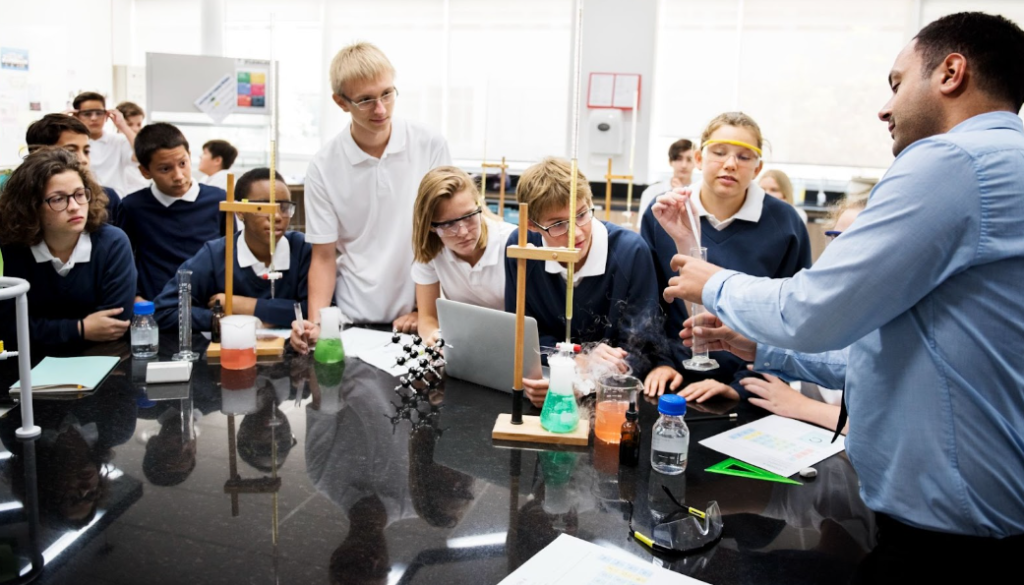
The science fair is an excellent place for those curious about our world’s composition to demonstrate their educational prowess for others to enjoy. However, it can also be quite daunting for someone who may not know where to start or what would navigate that middle ground between a passionate subject and a physical construction in said area of expertise.
Where can one find ideas for this task? No worries, we’ve got you covered. Here are five ideas to get you thinking about what you’re looking for in a science fair project! If none of these catch your fancy, they were all taken from ScienceBuddies.org, and there are plenty more experiments to choose from if you feel obliged to give them a look.
1. Extracting DNA from Strawberries
Link to Project: https://www.sciencebuddies.org/science-fair-projects/project-ideas/BioChem_p015/biotechnology-techniques/strawberry-dna
Let’s get down to the basics, such as DNA. There isn’t much to be said about DNA that hasn’t been extensively researched, but that’s also why it is a great project to work with. This example is simple and cost-effective but allows students to become a biotechnological engineer for a day and condense a strawberry into its purest form: its genetic composition.
To simplify the process so that the average person (or blog writer) would understand it, you use a chemical (dishwashing liquid, so nothing dangerous) to crack the cells open. Then, you attract the DNA with salt to group close to one another, and you separate the whole mixture with rubbing alcohol to show your audience what the biological instructions (DNA) for creating strawberries look like! It’s relatively easy but still pretty cool.
2. Musical Straws
Link to Project: https://www.sciencebuddies.org/science-fair-projects/project-ideas/Music_p016/music/do-re-mi-with-straws
Music is something that everyone inherently understands, but only some ever try to comprehend. How does good noise come from wooden and metal sticks, like clarinets and flutes? Sounds like the perfect idea for a science fair project! In this experiment, the student doesn’t need much more than the materials they likely already have at home: straws, a tape measure, and some sort of tuning app or musical instrument.
This project entails cutting the straws into a roughly “reed” shape, similar to the device an oboe uses to create its distinct timbre, and snipping off the other end to produce differing pitches of said instrument. While simple in theory, in concept, it can be pretty tricky to find exactly the perfect note, and if you’re off by a couple of cents, the band kids will likely notice! This project would pair well with some graphs explaining how sound travels through the air in wavelengths, with the straws acting as a visual aid rather than the explanation itself.
3. Homemade Wind Meter
Link to Project: https://www.sciencebuddies.org/science-fair-projects/project-ideas/Weather_p008/weather-atmosphere/how-does-a-wind-meter-work
Those weather forecasts…one moment, they tell you it’s sunny, and next thing you know, you’re knee-deep in rainwater. With this experiment, you can be wrong about the weather, too! (or right, preferably).
Anemometers are measuring devices that meteorologists use to measure wind speed, and surprisingly, they’re not that complicated. For this experiment, you’d need the standard office supplies (scissors, stapler, pencil, etc.) with some paper cups, straws (which is, let’s face it, the most versatile DIY material out there), a pin, and a fan with different speeds. Following the instructions on the website will grant you a homemade anemometer of your own, and once you add in a description of wind’s role in the formation of weather, you’re set to go for this week’s science fair!
4. Recognizing Faces with Neural Networks
Link to Project: https://www.sciencebuddies.org/science-fair-projects/project-ideas/ArtificialIntelligence_p016/artificial-intelligence/facial_recognition
Recognizing faces is something that most humans innately do instinctively, but it’s a whole different story regarding computers. It takes a ton of software, hardware, and lots of years in college to get your laptop to differentiate different humans by appearance…right?
Apparently not, because it’s on this list of high-school science fair ideas! While there is more prep work than previously mentioned projects, it’s fairly technical but straightforward.
The simplest explanation is this: You’ll take a bunch of pictures from person A and tell the machine, ” This is the person I want,” designating one as an “anchor image.” The machine will take this “anchor image” and these “positive images” and note the details that make up the person’s face (e.g., “they have a mole on their left cheek” or “their eyes are always blue”).
Then, you’ll continuously show it “negative images,” pictures of person B, C, D, and so on, and tell it, “This is not the person I want.” With each pass, you’ll train it to identify the person you want and the people you don’t want until this computer can reliably tell you from any picture of a human that “the picture is/is not person A.”
ScienceBuddies.org provides a more in-depth explanation for this process, but what can be certain is that this is a worthwhile project to explore for any computer geeks out there.
5. DIY Phonograph
Link to Project: https://www.sciencebuddies.org/science-fair-projects/project-ideas/Music_p032/music/make-a-phonograph
This project is likely the most physically complex, and for that, it’s the last on this list. The student will need tin cans, aluminum foil, rubber bands, sewing needles, scotch tape, latex balloons, scissors, and a plastic funnel. Here’s the kicker: three volunteers and a turntable or lazy Susan will be needed. These can be hard to find, so ensure you can acquire them head-on before entering this project.
The overall concept is that you can remove the tops and bottoms of the cans and keep the balloon (or foil, as it is an alternative material) on one end with the rubber bands and the needle taped an inch from the edge of the balloon/foil side. Then, someone will rotate the lazy Susan or turntable with a record on top, the needle of the can sticking into one of the ridges of the record, and you’ll record the sound quality for each can combination.
This project provides an exemplary view of the different parts that play into a phonograph and how it operates. It’s a great visual and auditory aid. Hearing the differences in action will definitely surprise other participants and the audience!
There are many ways to go about creating something for a science fair. As shown above, they come in all shapes and sizes, difficulties and costs. But at the end of the day, every teacher can attest that what matters is that the students learn something and have fun while doing it! Hopefully, these ideas can spur an excitement for an exciting field of study that’ll push forward long after a science fair. If not, then a fun little experiment will have to do. Either way, something of value will have been gained; that much is guaranteed.
By Noah Moster
Do you want more resources on the topic of Science Fairs? NSTEM’s vast resources database provides thousands of searchable STEM resources by category, school level, and state. This comprehensive library includes info on enrichment activities, curricula, internships, scholarships, and more. Check out a free sampling here. Or get an NSTEM membership today to unlock the complete list.
Project-based learning enrichment provides high school students with college and career readiness. It gives them real-world relevance, transforming students into collaborators and imaginative problem solvers. They will gain the upper hand in a global landscape, stemming from enhanced confidence and grit. NSTEM provides these young STEM enthusiasts with a close community of like-minded fellow students and educators. To start your 9-12 Chapter of the National STEM Honor Society, click here.