Tag: High School – 9th through 12th Grade

  • Astronomers find trove of massive black holes in dwarf galaxies

    Astronomers find trove of massive black holes in dwarf galaxies

           A team of researchers at the University of North Carolina at Chapel Hill discovered a hidden trove of massive black holes in dwarf galaxies. This trove of black holes had been previously overlooked, making this finding a key to our understanding of black holes in dwarf galaxies. 

           Black holes are typically detected when they are consuming gas and stardust, which makes them glow intensely. When they are not glowing, we are not able to detect them. 

           The problem is that black holes and newborn stars can emit a similar glow. Astronomers have a set of diagnostic tests that allows them to differentiate black holes and newborn stars. However, when the research team applied these tests to their data, they received mixed results. Two tests would indicate black holes, while the third test would indicate a star formation. 

           Research study coauthor Sheila Kannappan suspected that they might be undiscovered black holes in a dwarf galaxy. Coauthor Chris Richardson ran theoretical simulations with the mixed results and confirmed that the tests would match with a highly star-forming dwarf galaxy containing a growing massive black hole. 

    Source

           Mugdha Polimera, leading author of the study and Ph.D. student, set to work obtaining measurements, traditional and mixed message results, and surveys to test for black holes to confirm their work. She found that the new type of growing black holes were almost always in dwarf galaxies. 

           The researchers were elated with the results, which seemed almost too good. Their findings can lead to many new follow-up ideas and discoveries to help us understand black holes, including ones in our own Milky Way galaxy. 


    Sources:

           University of North Carolina at Chapel Hill. (2022, May 27). Astronomers discover hidden trove of massive black holes – “we all got nervous”. SciTechDaily. Retrieved May 30, 2022, from https://scitechdaily.com/astronomers-discover-hidden-trove-of-massive-black-holes-we-all-got-nervous/


    Written by: Vivien Chen
    May 30, 2022
  • A Comprehensive Guide to Parametric Equations

    A Comprehensive Guide to Parametric Equations

    In mathematics, parametric equations describe a pair of quantities as explicit functions of independent variables regarded as “parameters.” They are most commonly used to define the coordinates of points that comprise a geometric artifact such as a curve or surface, in which case the equations are referred to as a “parametric representation” or “parameterization of an object.” In this article, we will learn to graph plane curves and eliminate the parameter.

    Although, before all else, we will consider the empirical use of parametric equations in order to gain a conceptual understanding of it outside of purely abstract notions.

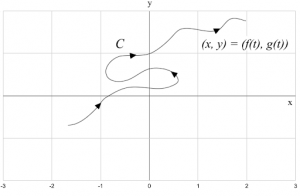
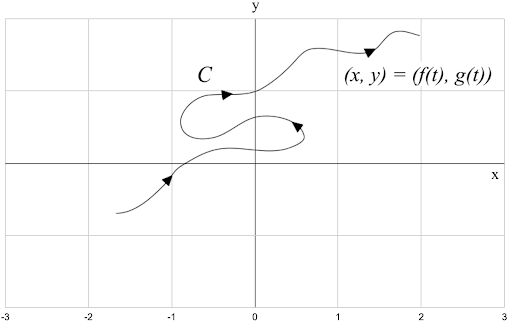
    Imagine a particle moving along a curve C, shown below.

    Image Credit-Estefania Olaiz

    It is virtually impossible to describe C with an equation in the form of y = f(x). This is because it fails the Vertical Line Test, which allows us to determine whether a curve in a graph represents a function. However, the x and y coordinates of the particle are considered functions of time. Therefore, we can consider it as x = f(t) and y = g(t). This should give you a practical idea of our topic of discussion.

    Graphing plane curves

    Graphing a plane curve involves plotting points in the rectangular coordinate system and connecting them with a smooth curve. To do this, we need to select values for t on a given interval, use the given parametric equations to calculate x and y for each value of t, and plot (x, y) in increasing order, as well as connect them with the smooth curve.

    Example: Graph the plane curve defined by the parametric equations x = t² – 1, y = 2t, and -2 ≤ t ≤ 2

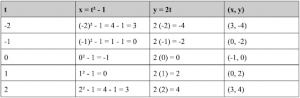
    Step 1.  Select values from the given interval. We will now choose integral values of t on the interval -2 ≤ t ≤ 2. Let t = -2, -1, 0, 1, and 2.

    Step 2.  For each value of t, use the listed parametric equations to calculate x and y. This is demonstrated by the table below, where the first column details the choices for parameter t, the following two columns depict the values for x and y, and the last column delineates the ordered pair (x, y).

    Image Credit-Estefania Olaiz

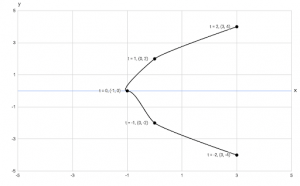
    Step 3. Plot the points (x, y) in order of increasing t and adjoin them with a smooth curve. The plane curve defined by the parametric equations on the interval is loosely represented below.

    Image Credit-Estefania Olaiz

    Note: The line is meant to be smoothed. 

    Eliminating the parameter

    The aforementioned graph shows x = t² – 1, y = 2t, -2 ≤ t ≤ 2. Even if we carefully scrutinize the equations, we may not be able to identify that a corresponding plane curve is a section of the parabola. By removing the parameter, we can create an equation that is equivalent to the parametric equations. To do this, we need to solve one equation for parameter t and substitute the value in the second equation.

    Example: x = t² – 1 and y = 2t.

    Step 1. Solve for parameter t.

    Solving for y = 2t, we get a result of t = y/2.

    Step 2. Substitute for t.

    Using the value t = y/2 and the equation x = t² – 1, we substitute. Therefore, we end up with x = (y/2)² – 1.

    In conclusion, we have just learned how to graph and eliminate parametric equations. A comprehensive approach to the subject will prove itself particularly relevant in a calculus class, more specifically, in an AP Calculus BC course.


    Written By: Estefania Olaiz

    Date: February 28, 2022

    Sources:

    1. https://www.britannica.com/science/parametric-equation

    2. https://en.wikipedia.org/wiki/Parametric_equation

    3. https://tutorial.math.lamar.edu/classes/calcii/parametriceqn.aspx

    4. http://rfrith.uaa.alaska.edu/M201/Chapter10/Chap10_Sec1.pdf 

    5. https://fl01000126.schoolwires.net/cms/lib/FL01000126/Centricity/Domain/261/Ch9_Section5.pdf

  • Record High Temperatures in Antarctica

    Record High Temperatures in Antarctica

    Image Credit

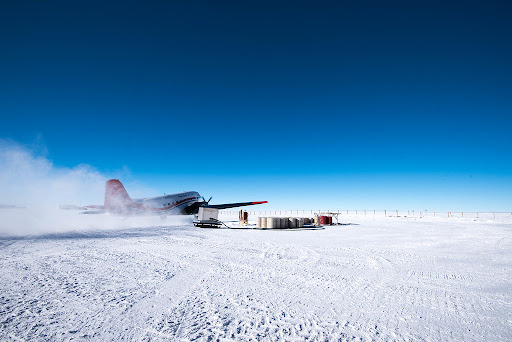
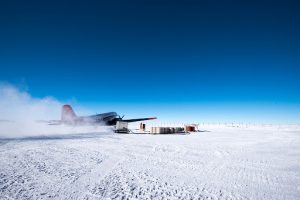
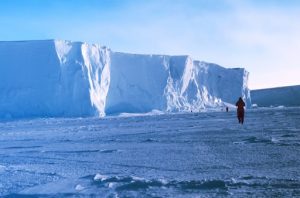
    On March 18, 2022, the Concordia research base at Dome C of Antarctica, one of the coldest places in the world, reported that temperatures had reached a shocking 11.3 degrees Fahrenheit, or -11.5 degrees Celsius. The research station is 9,800 feet above sea level, operated by French and Italian researchers. 

    March marks the end of summer in Antarctica. Normally, at this time of year, inland temperatures fall to an average of -56 degrees Fahrenheit (-49 degrees Celsius), making the temperature recorded on March 18 almost 70 degrees higher than usual. Scientists believe it has set a world record for the highest temperature above normal in any continent. 

    Researchers are scrambling to make sense of the occasion. Such an extreme meteorological event has never been observed in Dome C. It currently can’t be proven that climate change contributed to the drastic temperature change, but scientists have said that human-caused climate change almost definitely played a part, according to The Washington Post

    Other scientists are analyzing recent meteorological events for an explanation. An atmospheric river, a narrow passage in the atmosphere that transfers water vapor, had recently passed by and brought large amounts of ocean moisture onto the land. Just the day before on March 17, the ice sheet was almost the wettest it had been since 1980. There was also an arrival of hot air, which is very rare in the Antarctic at this time of year. The moisture from the atmospheric river could’ve trapped the hot air on the land and caused the heat wave. 

    This isn’t the only strange event that has happened in Antarctica in recent months. In late February, Antarctica’s sea ice level fell below 2 million square kilometers for the first time since 1979. On March 15, an ice shelf nearly the size of New York City completely collapsed, becoming the first Antarctic ice shelf in human history to collapse. This was most likely due to the incoming heat wave, as temperatures had already begun to reach record high levels at the time. 

    This event, while extreme, won’t have a very significant impact on Antarctica nor the rest of the world. However, it is important to keep an eye out for similar occurrences and what this could mean for the future.

    Image Credit

    Sources:

    www.cbsnews.com/news/antarctica-record-shattering-warmth-historic-event/ 

    www.cnn.com/2022/03/28/weather/antarctica-world-record-high-temperature-anomaly-climate/index.html 

    www.nbcnews.com/science/science-news/heat-wave-snowfall-researchers-are-puzzled-antarcticas-recent-weather-rcna21120 

    www.noaa.gov/stories/what-are-atmospheric-rivers 

    www.washingtonpost.com/weather/2022/03/18/antarctica-heat-wave-climate-change/ 

    earth.org/east-antarctica-ice-shelf-collapses-for-the-first-time-in-human-history/#:~:text=Following%20an%20unprecedented%20heat%20wave,human%20history%20in%20the%20region.


    Written By: Vivien Chen

    Date: March 31, 2022

  • The Importance of Music in Education

    The Importance of Music in Education

    Image Credit

    Overtime we have witnessed the elaboration and connection that links music and intelligence. Certain studies, typically conducted by universities, show the science that supports the fact that students who incorporate music into their education tend to perform better than their non-musical peers in subjects such as math, science, and language courses.

    According to a study of more than 100,000 students conducted by researchers at the University of British Columbia, students who were highly engaged in music were more likely to score higher across all subjects. In fact, students who started learning music early on and continued to do so in high school were shown to be one year ahead of their peers in terms of test scores. This trend was found to be especially true if the students were practicing instrumental music (APA).

    Image Credit

    One common counterargument to studies like this one is that the correlation between musical ability and academic achievement is not a direct relationship. Rather, some would argue that a variety of other factors are responsible for such findings and that music is not necessarily the link to higher scores or comprehension.

    Researchers at the University of Kansas conducted their own study to determine if the relationship between music and academic performance would still be found even if factors such as race and income were controlled. To the surprise of Martin J Bergee, who conducted the study, despite accounting for these variables they did not affect the outcome. Regardless of location, race, and income, students who played any instrument tended to perform better in education such as math comprehension than those who were not involved in any musical activity. (Science Daily).

    Image Credit

    The researchers at UBC hypothesized that the relationship between music and essential skills in the classroom may come from the teamwork, hand-eye coordination, and better listening skills learned from music classes where students must learn to read musical notation and keep in time with other musicians while also training their ears to recognize the relationships between various pitches (APA).

    But classroom benefits from music education are not exclusive to high school students only. One study published in 2014 in the journal Procedia – Social and Behavioral Sciences showed that musical education also enhances the development of children as young as three years old, specifically in the realm of language learning. The study determined that children who participated in music classes were better equipped for learning a second language (Procedia).

    Furthermore, based on research and skills developed we can determine that music may have a strong link between education and comprehension and is overall a beneficial subject for students in the classroom. It is beneficial to students of all academic fields, including STEM!

    Written by: Matthew Jenkins

    Date: 2/8/2022

    Sources:

    https://www.apa.org/news/press/releases/2019/06/music-students-score-better

    https://www.sciencedaily.com/releases/2020/11/201130150413.htm

    Influence of Music Training on Language Development. A Longitudinal Study – ScienceDirect

  • Cutting Down Waste In The Classroom!

    Have you ever sat back to think about how much waste occurs within your class? A Union of Professionals found that 4.7 pounds of waste is generated every single day, with a majority of that waste coming from schools. Check out these tips to help minimize the utilization of the three R’s in waste management: Reduce, Reuse, and Recycle! 

    Reduce

    The first way to make the classroom more eco-friendly is to reduce the amount of waste you’re creating. In a classroom, waste gets produced quickly through paperwork, material, or food packaging. According to Solo Resource Recovery, it’s important to reduce your waste in order to conserve landfill space, conserve resources, and most of all save energy. For those curious about how much waste is generated, try creating a trash tracker for your classroom! For every piece of trash, mark it down and count up how many marks you have at the end of the week. This information will make everyone more aware about the idea of waste elimination and can inspire people to start making a change. Instead of bringing your lunch in different bags everyday, maybe switch to a reusable lunch box. A fun way to reduce paper waste is to create a scrap paper box using an old cardboard box. With this, students will have scrap paper available for note taking, classwork, and projects! 

    Reuse

    The next and biggest way to cut down on waste in the classroom is to reuse! As mentioned above, bringing lunch in a reusable box is an easy way to eliminate waste. Similarly, instead of buying water bottles to bring, invest in a reusable water bottle and utilize water fountains around the school. Another way to reuse is through school supplies. Rather than buying a new set of scissors or colored pencils every year, try to hold on to them for the next school year or even donate them to the school for someone else to use. For teachers, a way to reduce paper waste is to print out assignments and laminate them. With this, less paper will be used because students can share and they can be reused multiple times! 

    Recycle

    The final step, and the one most people are familiar with, is recycling! In order to recycle properly, it’s important to know what is recyclable. Some items in a typical classroom that are recyclable are cardboard, magazines, paper, plastic bottles, plastic bags, and aluminum cans. To identify where you can recycle these items, look for blue trash cans with the recycle symbol on them. According to A Union of Professionals, even recycling just one glass bottle can save enough energy to power a lightbulb for four hours.

    Now that you’ve learned about how you can help save the environment through your school, go forth and show it off! If you enjoyed these tips, you can check out other blogs at https://nstem.org/staging/blog/

    Written by: Kathryn Cottingham

  • Ultimate College-Preparedness Checklist!

    Ultimate College-Preparedness Checklist!

    Image credit

    College might seem light years away when you enter your first year of high school, but it is closer than you may think. Those four years will fly by and soon you will have to make a decision on which path to take in your senior year. The earlier you start planning for college, the easier the decision will be. Here are some things you should keep in mind during each of your high school years to prepare for college applications!

    Freshman Year

    Freshman year provides you with a clean slate. The first two years of high school are critical for setting up good academic habits, and freshman year is when you should focus on your grades. Master successful study habits and consider taking higher level courses, such as AP classes if your school offers them. Some colleges want to see if you can succeed in taking rigorous courses in high school because that can give them an idea of how you will do in college. If you need help keeping your grades up, make sure to ask for extra help.  

    Also use this time to start figuring out your interests. Joining different types of clubs or other extracurricular activities, such as athletics or volunteer work, can help you determine what you are passionate about.

    Sophomore Year

    Sophomore year is when you should take either the PSAT or the Pre-ACT. These are practice tests that you will take at school which help you prepare for the SAT and ACT. You should take these tests seriously and begin studying the subjects as soon as possible, so ask your counselor when the PSAT or Pre-ACT will occur. You can then use the scores received from the PSAT or Pre-ACT to improve your skills for the following year. 

    Throughout the year, you should start thinking about how you will pay for college. Talk to your parents and see if they will help financially. Find a job to start earning money that you can put towards college, and research scholarships that you can apply to.

    Remember that being involved in clubs and extracurriculars is not only for freshman year, but should last throughout all your high school years. In sophomore year, try to take on a leadership role that will grab the attention of college admissions. 

    Junior Year

    Junior year should be the time when you start putting plans in motion. Research colleges and universities, and try to figure out what field of study you may want to pursue. Do you want to be in-state or out-of-state? Does the prestige of the college matter to you? How do the colleges rank in the fields of study you are interested in?Make a spreadsheet of all the colleges you are considering applying to. You can even start visiting campuses to see if they are the right fit for you.

    You should also register to take the SAT or ACT. You have the option of taking both or just one, but you should choose one that shows off your strengths the best. You can retake these exams until you are satisfied with your scores, but you do have to pay for them. Speak with your school counselor to see if you are eligible for a fee waiver.

    Now you truly have to begin working on your college applications. Start asking your teachers for recommendation letters towards the end of the year. Most schools require them and you should give your teachers enough time to finish them by the start of your senior year. Start drafting your college essays and sign up for Federal Student Aid (FAFSA). 

    Senior Year

    Senior year is the year you will officially start applying for college. In the beginning of the year, narrow down your college options. Meet with your school counselor and see what they think of your college prospects. On another note, ensure you are meeting all your high school graduation requirements so far. 

    The time you apply for college is up to you. Many colleges have different options for applications that vary in the timing of deadlines. For example, you can apply early action, early decision, or regular decision depending on the options that the college offersPay attention to individual college deadlines when applying. Complete all your financial aid forms and apply for any additional scholarships you desire.

    Submitting all your applications does not mean you can slack off. You need to keep an eye out for things like acceptance letters, additional document requests, and financial aid offers. Take in everything one at a time and think about what path is best for you when you have to make your final college decision. 

    Image credit

    Applying for colleges sounds like a difficult task, but if you follow these guidelines, things will be a lot simpler. Please know that you are not the only student going through this so talk it out and get help from your peers if needed. You can all get through it together!  

    Sources:

    1. https://www.goingmerry.com/blog/college-readiness-checklist/
    2. https://studentaid.gov/sites/default/files/college-prep-checklist.pdf
    3. https://www.connectionsacademy.com/support/resources/article/getting-ready-for-college
    4. https://www.hesc.ny.gov/prepare-for-college/your-high-school-path-to-college/checklists/senior-checklist.html
    5. https://goingivy.com/college-admissions-consultants/when-should-i-start/#:~:text=Some%20experts%20recommend%20starting%20as,be%20of%20benefit%20to%20you


    3 Key Phrases:

    1. Those four years will fly by and you will have to make a decision on which path to take in your senior year. The earlier you start planning for college, the easier the decision will be.
    2. Also use this time to start figuring out your interests. Joining different types of clubs or other extracurricular activities can help you determine what you are passionate about.
    3. Submitting all your applications does not mean you can slack off. You need to keep an eye out for things like acceptance letters, additional document requests, and financial aid offers. Take in everything one at a time and think about what path is best for you when you have to make your final college decision.


    Written by: Amanda Aber

    January 19, 2022